Tuesday, 21 July 2015

A Brief History of the Food Booth

By: Kathy Watson


One day as I was working in the food booth at Lang Pioneer Village reading the Village Vignettes Blog on our website, Elizabeth King my supervisor for the day, came in to see if I needed anything. We started talking about the blog and somehow she convinced me to write a story about the Food Booth.  So here goes nothing!

Many people, when they visit Lang Pioneer Village, do not realize that one of the first buildings they see when walking west from the parking lot is the Museum Refreshment Booth also known as the Food Booth. Some visitors even mistake it for the Admissions, which it was at one time, sharing space with the original main office. It was used as a temporary building then. Construction of a new main building in 1983 resulted in the transfer of staff, leaving the temporary one empty and eventually it became the Food Booth.

Since 2007, the year I started working at Lang Pioneer Village, I have seen the following upgrades and improvements to the Food Booth:

  • A new deck and accessibility ramps were built onto the east side of the building
  • A shed was built by some of our fantastic volunteers to accommodate our small barbecue
  • A second water tap assembly was installed for the 3 sinks
  • A canopy was erected over the deck to provide shelter from the elements
  • A small fridge was installed to hold condiments and dairy products
  • Beautiful geranium hanging baskets were added to make it look pretty
  • A portable air conditioner was installed to help keep us cool on some very hot summer days
  • New shelving under the front counter was installed to improve storage space
  • New flooring was installed in the front of the food booth
  • In 2013 a brand new large commercial barbecue was purchased to serve the many visitors we have during school programs and special events
  • Skids were laid down in the back room to hold our Pepsi products
  • Shelving units were put in to hold some inventory
  • The old stairs were removed and a new accessibility ramp with handrails was built for easier access into the food booth
  • A new water pump was installed in the spring of this year
  • Also this year there has been some redecorating done inside and outside. New counter curtains, new menu chalkboards, a large blackboard to list our drink and chip choices and containers with lids for our potato chips have all improved the Food Booth's appearance.

Some of our products and procedures have also changed over the years. Due to health and safety concerns, we discontinued selling french fries, but some of our products like barbecued meats, veggie burgers and nachos and cheese, are still visitor favourites. We also sell frozen treats, cold drinks, popcorn and chips.

This is my 8th season in the Food Booth and I have developed a deep passion for it. I have learned a lot in researching its history and I hope you will drop by and say hello to myself and the rest of the Food Booth staff when visiting Lang Pioneer Village!


Kathy Watson- Part-time seasonal employee at Lang Pioneer Village for 8 years.

Tuesday, 14 July 2015

The Swing


This handkerchief was hand-crafted by Rhonda, at Lang Pioneer Village Museum, in July of 2015. It is reminiscent of the Robert Louis Stevenson poem “The Swing”:

The Swing
By Robert Louis Stevenson

How do you like to go up in a swing,
Up in the air so blue?
Oh, I do think it the pleasantest thing
Ever a child can do!

Up in the air and over the wall,
Till I can see so wide,
Rivers and trees and cattle and all
Over the countryside—

Till I look down on the garden green,
Down on the roof so brown—
Up in the air I go flying again,
Up in the air and down!


Submitted by Audrey Caryi and Rhonda Akey

Tuesday, 30 June 2015

Loading and Firing a Brown Bess Musket

By Trevor Merriam

Trevor with his Brown Bess Musket

It’s a 75 caliber smooth board. 


It is the type of musket used in service with the British and Colonial Forces from between 1680 and 1839 (approx.)

A close-up of the Brown Bess Musket and a cartridge

The cartridge is filled with 75 grains of black gun powder. 

It would have been wrapped using the equivalent of modern day newsprint.  

 
A second close-up, this one showing only the cartridge

Setting the hammer on the half-cock or safety position

Trevor biting the edge off of the cartridge
 
Trevor sprinkles the powder in the priming pan

The powder in the priming pan
 
Trevor closes the frizzon

Trevor pours the remaining powder down the barrel.  At this point, in combat, you would also place a 75 caliber bullet down the barrel.  (We did not do this!)
 
Trevor wads the cartridge paper and put it down the barrel
 
This is called ramming it home

An up-close shot of Trevor ramming it home

At the order of ready, you cock the hammer

The next order is aim

“FIRE!”


Trevor Merriam is the Premises Assistant at Lang Pioneer Village Museum.  He has been working at the Museum for 10 years and has a passion for history.

Tuesday, 23 June 2015

Discovering the Gramophone

By Kelley-Anne

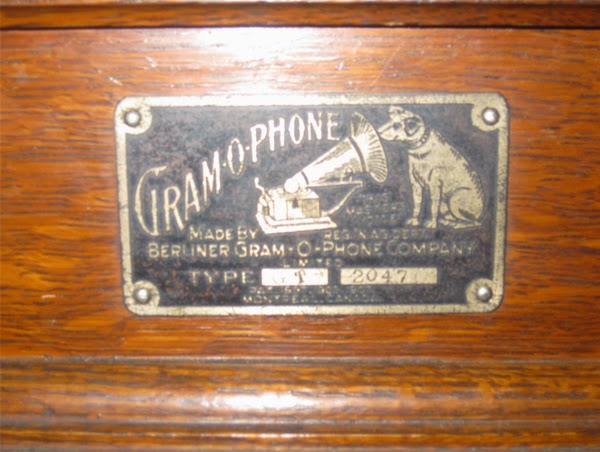
I was very fortunate to be given the opportunity to check out some fascinating artifacts here at Lang Pioneer Village Museum. As I was searching, I came across what I believed to be a record player that I found intriguing so I decided to go further into research.

In 1877, Thomas Edison invented the phonograph but it was only able to reproduce recorded sound with the use of a tinfoil sheet phonograph cylinder and proved to be too difficult for many people to use. Ten years later, in 1887, a German-born American inventor named Emile Berliner built on the ideas of Thomas Edison’s design and created the gramophone. He changed the tinfoil covered cylinder that was used to produce sound to a device that was able to rotate a hard rubber disk on a flat plate that could be turned by a crank to create sound. But as with the phonograph, the gramophone could only play recordings, so in 1895 Berliner established Berliner Gramophone Company, which not only produced gramophone machines but records that could be played on them as well.


Obviously this isn’t how the gramophones looked when they first came out- they would have been put together properly and not have a coating of dust on them, though they are still in great shape for having been around for more than 100 years.


Kelley-Anne is a grade 10 student at Trinity College School and guest writer for the Museum. 

Tuesday, 16 June 2015

Sawyer-Massey Steam Engine

By Graham Varrin


Lang’s Sawyer-Massey Steam Engine came to the Village in 1985 to replace our previously decommissioned portable George White Steam Engine. The Sawyer-Massey is a traction engine and has served Lang for almost 30 years.

Two years ago, the Steam Engine was decommissioned as the boiler had become too fragile to use. During the last two years, we have researched the different options to repair or replace the Sawyer-Massey. The costs for all options are high and it was determined that we could repair our existing Sawyer-Massey with a brand new boiler allowing us many years of service in the future. The Steam Engine will be making the trip to Oliver’s Boilers in Auburn, Ontario where the new boiler is currently being built. The engine will be dismounted from its boiler and remounted onto the new boiler with any necessary repairs being done along the way to the engine.

When the Sawyer-Massey returns next season, Lang Pioneer Village will have the only known brand new old steam engine in the Kawarthas. It will be available for everyone to see the incredible use of steam power which was once used in rural Peterborough County.

Lang's Sawyer-Massey Steam Engine


Graham Varrin is the Premises Coordinator at Lang Pioneer Village Museum.  He has been working at the Museum for four years. 

Monday, 8 June 2015

June 8th

By Karis Regamey


Today is June 8. Now, in my world, June 8 is just a normal day. There is no great significance, no special events, it’s just another day - in this case, a Monday. So why am I writing about June 8? To be very honest, I had nothing else to write about! 

So I decided to Google June 8, just for the fun of it. Although June 8 does not seem to be a noteworthy day, the day has significance in history. Wikipedia sites a long list of events that took place on June 8. 

Here are just a few:

  • 1042 – Edward the Confessor becomes King of England, one of the last Anglo-Saxon kings of England.
  • 1776 – American Revolutionary War: Battle of Trois-Rivières – American attackers are driven back at Trois-Rivières, Quebec.
  • 1783 – Laki, a volcano in Iceland, begins an eight-month eruption which kills over 9,000 people and starts a seven-year famine.
  • 1789 – James Madison introduces twelve proposed amendments to the United States Constitution in the House of Representatives; by 1791, ten of them are ratified by the state legislatures and become the Bill of Rights; another is eventually ratified in 1992 to become the 27th Amendment.
  • 1906 – Theodore Roosevelt signs the Antiquities Act into law, authorizing the President to restrict the use of certain parcels of public land with historical or conservation value.
  • 1928 – Second Northern Expedition: The National Revolutionary Army captures Peking, whose name is changed to Beijing ("Northern Capital").
  • 1953 – An F5 tornado hits Beecher, Michigan, killing 116, injuring 844, and destroying 340 homes.
  • 1953 – The United States Supreme Court rules that restaurants in Washington, D.C., cannot refuse to serve black patrons.
  • 1959 – The USS Barbero and United States Postal Service attempt the delivery of mail via Missile Mail.
  • 1968 – Robert F. Kennedy's funeral takes place at the St. Patrick's Cathedral in New York City.
  • 2007 – Newcastle, New South Wales, Australia, is hit by the State's worst storms and flooding in 30 years resulting in the death of nine people and the grounding of a trade ship, the MV Pasha Bulker.

This is just a sampling of the events that have taken place on this date throughout history. To see a complete list, please visit http://en.wikipedia.org/wiki/June_8.

One item on the list that stood out to me was that on June 8, 1949, George Orwell’s Nineteen Eighty-Four was published. Nineteen Eighty-Four was a novel that I was required to read for English class in high school. If you aren’t familiar with the book, Nineteen Eighty-Four is set in Oceania, primarily in the city of Airstrip One (formerly Great Britain) where there is constant government surveillance. The land is controlled by the Inner Party, Big Brother being the party’s leader, who are solely interested in seeking power. Posters of the party leader with captions “Big Brother is Watching You” dominated the city. 

The population is broken into three hierarchies: The Inner Party (upper class making up about 2% of the population), the Outer party (middle class making up about 13% of the population) and the Proles (lower class- the remaining 85% of the population). The Party controls the population with four ministries: The Ministry of Peace, the Ministry of Plenty, the Ministry of Truth and the Ministry of Love. 

The story follows the protagonist, Winston Smith who is a member of the Outer Party and works for the Ministry of Truth. His job is to rewrite past newspaper articles so that the historical record always supports the party line. Winston secretly hates the Party and dreams of rebelling against Big Brother. The story follows Winston through his rebellion and the government’s punishment when he is eventually caught. 

By 1989, Nineteen Eighty-Four had been translated into sixty-five languages, more than any other novel in English at the time. In 2005, Nineteen Eighty-Four was chosen by TIME magazine as one of the 100 best English-language novels from 1923 to 2005. 
Nineteen Eighty-Four was influenced by World War II. Orwell believed that British Democracy as it existed before 1939 would not survive the war. He later admitted that he had been wrong. Orwell wrote in his 1946 essay entitled “Why I Write” that “Nineteen Eighty-Four is a cautionary tale about revolution betrayed by totalitarian defenders” (Source: Wikipedia- http://en.wikipedia.org/wiki/Nineteen_Eighty-Four).

June 8, 2015 may just seem like another, ordinary, non-spectacular day in my world, but it sure is significant and has been significant to many people throughout the years. Who knows what today’s five o’clock news will report. All I can say is I sure am glad that our world today is not as George Orwell predicted in Nineteen Eighty-Four which was published on this day 66 years ago!


Karis Regamey is the Marketing Consultant for Lang Pioneer Village Museum, She has been with the Museum since February of 2009. When she is not busy overseeing the advertising of the Village, she can be found chasing after her two little ones.

Tuesday, 2 June 2015

Proof Spirit

By Caitlin


The most interesting thing at Lang Pioneer Village is that visitors are able to compare and contrast their lives and the technology we all live with, to the technology and ways of life during the 1800s. An artifact that I found to be interesting was an instrument used to measure alcohol levels in drinks. This instrument was a small round, wooden box filled with small glass beads of different sizes. The lid of the box read, “If it be proof, the Bead will sink to the Bottom,” meaning that whichever bead sank to the bottom indicated the strength of the alcohol.

The “proof spirit” of alcohol is the standard amount of alcohol the beverage contains. During the 19th century, alcohol was considered to not only be a social crisis, but also one of the spirit so it’s safe to assume the standard would be much lower than it is today. The temperance movement happened during the Social Reform in the early 19th century where people everywhere stood against alcohol and drinking in general. They believed that sobriety would better the society; it would increase workplace productivity and decrease workplace injuries. That being said, knowing the strength and alcohol content of a drink would have been important during this time period.

Today, alcohol levels are measured by alcometers or vinometers. These measurement devices are long thin tubes that resemble needles or thermometers. It would be interesting to know how each instrument works, especially how the artifact would have worked and why it was that a certain bead would drop.  


Alcometer and vinometer


Technology has come a long way, that’s for sure!


Caitlin is a grade 10 student at Trinity College School and guest writer for the Museum.