Tuesday, 22 September 2015

The Keene Hotel

By Catriona & Katherine

Welcome to the Keene Hotel! This hotel was built just over 30 years ago, in 1836. We encourage all of you weary travelers to stop by and experience the comforting and home-like environment that we offer each of our guests.


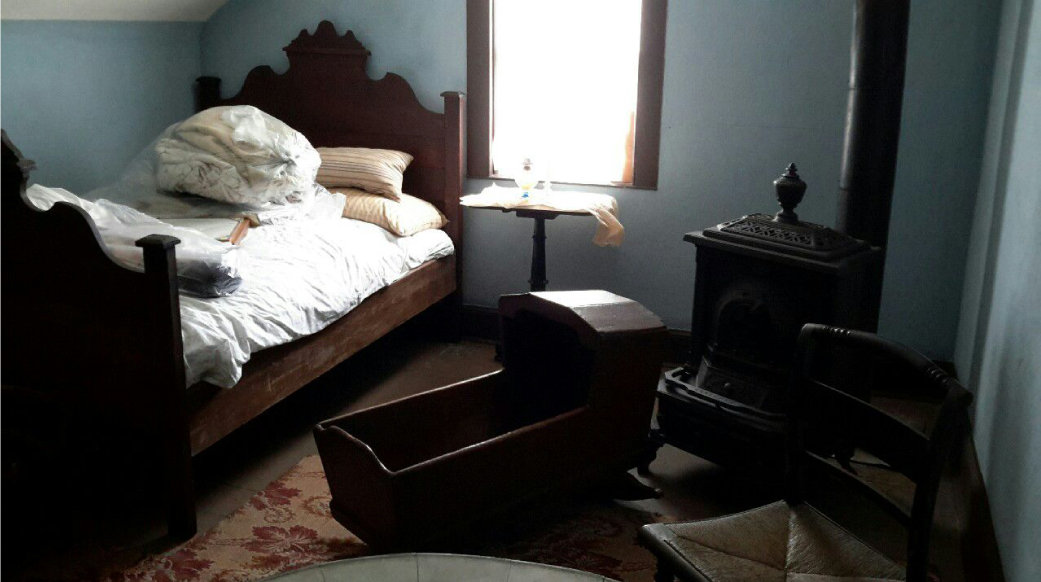
Will you be staying in one of our rooms? We offer three different styles of rooms: our “Best Room” ($0.75/night) offers a double bed, closet space and a bathing tub, our “Second Best Room” ($0.25/night) offers two small double beds and a shared room, and finally our regular accommodations, “The Flop Room” ($0.10/night), offering straw ticks on the floor (blankets and pillows not included).

Best Room

Second Best Room

Flop Room


We also offer a bar room for conversation and where one can get a nice shave for the men and a sitting parlour with a small powder room for the ladies. These rooms are available to our guests at all times.

Bar Room

Sitting Parlour


A hot dinner will be served promptly at 6 o’clock pm in the dining room. Please ensure that you are washed and presentable. A morning meal will also be served at 6:30 am. No midday meal is available, however, the General Store is right next door for any necessary shopping. We have a room for salesmen and seamstresses to work and sell their goods during the afternoon. There is tea available after Sunday service.

Dining Room


We are keen for you to join us at the Keene Hotel! We hope you enjoy your stay.
- Martin & Mary Jane Kennaley, 1870


Catriona and Katherine are students at Trinity College School and guest writer for the Museum.

Tuesday, 8 September 2015

Pioneer Games

By Hayley Nabuurs

Games during the Victorian era varied based on people's social class and age. Despite the differences, games were an important part of most pioneer's lives, adding a bit of fun and play into an otherwise hard life.

Parlour games were popular with both children and adults. These types of games tended to be focused around logic and words rather than exercise. Parlour games were particularly popular with upper to middle class people who actually had leisure time. Despite being older games, some of these are still played today. Some examples of these are charades, twenty questions, musical chairs, and pin the tail on the donkey. Many more have familiar names but the actual game itself may not be universally known. An example of this is tiddlywinks. To play, players must use a disk to flip another smaller disk into a cup. This game got competitive fast, and it was common for Victorian's to practice their flick techniques in order to win the next round. Another interesting game is one called Deerstalker. In this game one player is the "deer" and the other is the "hunter". Both are blindfolded and positioned at opposite ends of a large table. One of the onlookers says "Go!" and the players begin to circle the table. The key is for both the players and the audience to be absolutely silent. The game is over when the hunter catches the deer.

Another popular type of games, which were mostly played by children, were outdoor games. Like parlour games, some of these are still played today. Some examples of these are tug of war and hopscotch. Others have decreased in popularity but are still very fun to play. One of these games, which we tend to play at the Village, is Graces. Graces was originally designed in the 1830s to be played by young ladies in order to let them exercise but in a graceful way. The game is designed for two people with each player holding a pair of sticks and a hoop. One player crosses their sticks and launches their hoop up into the air at their partner. The other player tries to catch the hoop with their pair of sticks. This game is always a hit with staff, volunteers, and visitors alike.


All of these games were important parts of Victorian and pioneer pop culture and helped to fill the day before the advent of radio and television. Feel free to play these games the next time you are with a group. They are just as much fun now as they were in the 1800s. 


Hayley Nabuurs works as one of the seasonal staff interpreters at Lang Pioneer Village. She has been working at Lang for 4 years and volunteered before then. 


Tuesday, 1 September 2015

Facial Hair

By Hailey Doughty

The greatest thing about history is that every detail of it has a story. Being a historical interpreter, I am fortunate enough to learn and tell these stories from hundreds of years ago. But even though I spend most of my summer completely immersed in history, I still find myself being amazed at the stories that we uncover from the smallest of artifacts. I like to think of them as little glimpses into what life was really like hundreds of years ago. Recently I was fortunate enough to find one of these glimpses myself and uncover a story from a simple artifact that I had seen almost daily… a barber’s chair. This chair, sits neatly in the corner of the Keene Hotel Bar Room, unbeknownst to visitors of the story its worn, patterned floral seat and faded chestnut wooden arms hold. For this blog post, I want to transport you, the reader, back in time to learn the story of this chair, and many other barber tools, in the popular culture of men’s facial hair in the mid 1800’s onward.

Imagine for a moment you are a man in 1850. A new trend has swept the country of Canada- men’s facial hair. Prior to this time, men’s facial hair was seen as an indication of your social standing. If you had facial hair it was presumed that you were part of the middle to lower classes because only the upper class and those of the nobility had both the time and expenses to shave their faces. But now a new age has come where you, a middle class man, are seen in a higher regard for your beard; for in 1850 this is the facial hair of choice. All the influential figures and leaders at this time are wearing the same popular style of facial hair as you, such as Charles Dickens and Karl Marx. Your style choices for this era are dependent on you, for you will be your own barber. Do you choose to let your beard grow with a nice full moustache or do you opt for a chin beard and use your straight razor for the nice clean shave on your upper lip?


Travel 20 years into the future. You are now a man in 1870. Standing outside of the Keene Hotel, you hear the laughs of men coming from inside. Following the chatter you step up the white steps, entering into the Bar Room, the smell of alcohol and smoke fill your nostrils. The hum of many men chattering, is now louder and you can see a card game in session with a few men. Looking around the room you notice the new addition of a barber’s chair with numerous tools around it. A man standing beside the chair, looks at you, with a grin on his face he asks “What will it be today lad?  A cut or a shave?” 


Now that it is 1870, facial hair has grown in popularity and the whole trend as broadened to various different styles since the 1850’s beards. Styles include chinstraps, mutton chops, handlebar moustaches and everything in-between. Not only have the styles changed, but the whole culture of it has developed into a country wide phenomenon. Almost every man at this point has some style of facial hair and the days of clean shaven faces are a thought of the past. Now barbers are the primary source of facial hair trends and the process of up keeping ones facial hair.


Next, our journey puts you in 1901. You are standing in front of the Menie General Store. News has just broken of a revolutionary device that has hit the market! The new Gillette safety razor, the very first of its kind that has a disposable blade for a close shave every time! For sale for a starting price of $5.00 (which equals about 140 dollars today). The creation of this invention modernizes razor technology of the time, from the old straight razors and hand powered clippers to disposable safe razors. News of this excites the men gathered around the front porch talking, walking up the steps of the general store, you note their moustaches that are each precisely combed and styled with a small curl at the end. One man notices you looking, he states “Your moustache is looking a little dull there chap” directing you with his finger to the shelf full of products inside.


On this shelf you note various shaving creams each claiming of having a special ingredient to either soothe or soften the skin. A poster pinned beside the shelf advertises a new wax that claims miraculous results to your hair, including strength. But one shelf is dedicated to flowered gold lined tea cups, upon further investigation you notice it is a man’s tea cup called a moustache cup.


The purpose of this cup is to prevent the heat of the steam from the tea melting the wax of a man’s moustache. It does so with the use of a small lip that holds the moustache away from the tea; thus allowing the man to enjoy his tea without disturbing his finely styled facial hair. With the increase of popularity in the 1980’s to the turn of the century, a lot about facial hair has changed. Not only are there new inventions and products helping in the upkeep of facial hair, but barbers are being considered a professional trade. Barbers at this time had become quite distinguished as a group with the optimum goal of being titled as a "master barber" and to swear the barber’s oath. This trade was taken so seriously that barbers began being educated in the anatomy of hair and skin to provide the best consultation for their customers.


Present day, you are a visitor at Lang Pioneer Village Museum, standing in the Keene Hotel Bar Room. You notice how quiet it is, you hear the faint sound of the historical interpreter down the hall. You look around at the tables that are empty, with each chair positioned neatly underneath them. You then notice that sitting in the far right corner is a barber’s chair. You walk towards it noticing its worn, patterned floral seat and faded chestnut wooden arms. Looking at it you imagine the many men who sat in that chair, the cuts they must have gotten and the barber who spent most of his days there. As you go to leave, you look back one last time and think to yourself … that chair must have a great story. 


Hailey Doughty is part of Lang Pioneer Village Museum's seasonal staff team as an historical interpreter. She is also a 3rd year Psychology student at Trent University. 

Tuesday, 25 August 2015

A Thoughtful Use for Wood Shavings – Introducing the ‘Spill Plane’

By: Jill Chapman,
In dialogue with: Rob Paul, Research & Collections Volunteer


Usually a wood plane is used to shave a piece of wood to a desired shape, and the shavings become waste. There is a special type of plane; however, a Spill Plane, whose only purpose is to produce a special long coiled shaving called a ‘spill’.

The spill was used to transfer a flame from one location to another. For example, one could take a flame from a fireplace to light a candle, lamp or pipe tobacco. Spills burn more slowly and more consistently than paper. They were most popular in the days before matches became widely available (1860s).

There are many different designs of spill planes as they were commonly home-made. Once a spill plane is constructed, you simply push a piece of wood over the blade to make the long tightly-curled shaving. Straight grained softwood, such as pine, makes the best spills.

There were no spill planes available in the Lang Village archives, so Research & Collections Volunteer, Rob, decided to try making one from some scraps of wood and a spare blade.

Here's the result of his first attempt…


Spill Plane- Action Shot

…It works!!!

Rob dazzled the office by allowing me (Jill) to test his creation. It worked in a simple and effective manner, a true remark of his fine craftsmanship. We experimented with different ways holding the wood piece while applying varying degrees of pressure to create the greatest spills. Note the assortment of test pieces (see photos).

Rob noted that while the spills are usable, they should really be a bit more tightly curled. He looks forward to fine-tuning this prototype in order to improve the product.

Spills- Transferrers of Flame!
Spill Plane- Aerial View

We certainly look forward to seeing the Spill Plane be put to use in the Village! Thank you Rob for sharing your skills and research with the Lang community!


Jill Chapman is the Visitor Experience Coordinator at Lang Pioneer Village Museum. She has been a member of the Lang team since May of 2012. Jill is a passionate advocate for education, the arts and fitness. When not at work, Jill might be found running through the North Cavan foothills or on one of the County’s rotary trails.

Tuesday, 18 August 2015

Carpe Dime - Seize the Coin!

By: Janelle Kelcey

A few weeks ago, I was sweeping the floor at Muddy's Pit BBQ at the end of the night when I happened across a coin in my pile of dirt, which isn't uncommon. Imagine my surprise when I picked it up to find the date inscribed on the dime was 1874!
Front of the coin

Back of the coin


The next morning I brought the coin with me to Lang (then nearly lost it near the Fife Cabin's fire pit!) and added it to Lang's collections.

This coin prompted my thinking - what could it have been used to purchase in 1874 when it was freshly minted? With some research, I came up with the following list:

  • One copy of the local weekly newspaper (annual subscriptions could be purchased for $2-$5, depending on the publication)
  • A simple, unadorned children's leather pocket book with 4 pockets 
  • Half a dozen lead pencils (non-rubber tipped)
  • A glass 1-gallon jug
  • One pound of sugar
  • A necktie "designed to supersede all other methods for fastening the bow to a turndown collar"
  • 1 yard of cotton goods, best prints
  • Simple ladies gloves, fleece-lined

Although 10 cents doesn't seem like much money in today's economy, by using an inflation calculator we learn that something that cost 10 cents in 1874 would cost around $2.06 today. We must also consider that wages and workdays were much different in 1874, and wages would differ based on a worker's skill-set and location as well.

  • In the manufacturing industry, male weavers could expect to make between $1.13 and $1.20 per day, while a female weaver would only earn between $0.94 and $1.03. If you were employed to repair the looms, you would make between $1.32 and $2.20.
  • Blacksmiths in 1875 could expect to make between $2.09 and $3.50 per day, a carpenter between $2.15 and $3.06 per day, and a painter between $2.15 and $3.97 per day.However, these wage rates are only representative of the manufacturing industry and do not represent the earnings of independent tradesmen.
  • Doctors would make upwards of $5 per day, with most receiving an annual salary of $2000-$3000 per year.
  • Teachers could make between $0.88 and $2.38 per day depending on if they taught in a city or rural area, and if they were male or female.

Of course we then must also take into account the value of specific items, as that can also change over time. For example, the value of coffee has increased 15 times over what it was worth 200 years ago. Products such as whale oil, bustles, washboards, lanterns, and tin-ware have fallen out of demand with the change of the times, while the value of spices have dropped dramatically with globalization and improved methods of transportation. Technology has also been used in production of modern goods to increase efficiency, keeping prices low.

An example of technology’s effect on product value can be seen in transportation technology between the 19th and 20th centuries. Demand for horse drawn carriages and wagons was high throughout the 19th century as a main method of transportation, but with the advent of the automobile, demand gradually fell. Initially only the wealthy could afford to purchase a vehicle, but in the 1910s and 1920s, Ford began using assembly lines to manufacture their vehicles, cutting down costs and effectively lowering the price so that the middle class could afford to own a car as well. This drastically lowered the demand for carriages and wagons, thus lowering their value.

Today, this coin is worth around $25. Since this coin has been in circulation, the detail on the design has been worn down, though all the words are still legible. High quality 1874 dimes with some shiny lustre remaining can be worth over $100! The same coin if it had been in "mint" condition (never in circulation) would be worth over $1300!

Although the monetary value of the coin has depreciated, the historical value has increased the overall value. So keep a hold of your coin collections - you never know how much they may be worth in the future!


Sources:
Catalogue no. 13, Spring and Summer, 1875. Montgomery Ward, Chicago, 1875.

Clarence D. Long. "The Course of Money Wages during 1860-1890". Princeton University Press, 1960, p. 13-38.

Macon [Daily] Telegraph,    Macon Georgia, October 31, 1861, p. 3.

Stockdale, Charles B. et al. "The History of What Things Cost in North America", September 16, 2010.

http://247wallst.com/investing/2010/09/16/the-history-of-what-things-cost-in-america-1776-to-today/.


Janelle has been a seasonal interpreter at Lang Pioneer Village for three years. She is a recent graduate of Queen's University and her areas of historical interest include local histories, ethno and historical musicology and history education. 

Tuesday, 11 August 2015

Ode to David Fife- Part 3

By Gary Fife

The following is the final segment of a poem written by Gary Fife, the Great-Great Grandson of David Fife.


PART II – REVIVAL OF RED FIFE WHEAT

Section I – Saved from Extinction

In 1988, Sharon Rempel initiated the Heritage Wheat Project [1]
She believed heritage wheat had been the subject of neglect
Of all the heritage wheats that were embraced
Red Fife thrashed them all in milling and baking qualities and taste
Rempel had a vision that one day Red Fife would be re-commercialized
Organic farmers, artisan bakers, pastry chefs and consumers would crave this grain so prized
The Red Fife Wheat Project does not want GMO
Rempel believes it is not the way to go

In 2001, Marc Loiselle, began growing Red Fife on his organic Saskatchewan farm [2]
The landrace wheat quickly adapted to the soil and could do no harm
Demand for Red Fife quickly spread across the land
Artisan bakers and discerning pastry chefs developed it as their own brand
Loiselle describes Red Fife as unexpectedly rich with a slightly herby and spicy flavour
With aromas of anise and fennel and a nutty taste to savour

In 1989, eco-gastronomists founded the International Slow Food Movement [3]
An alternative to the tediousness of fast food, it was a major improvement
Slow Food promotes food that is good, clean and fair
Their Ark of Taste is a project to catalog heritage foods to share
Only the best tasting endangered products make it onto the Ark
Foods at risk of extinction receive a check mark
The Slow Food Presidium Project would save foods from extinction
Promoting traditional forgotten foods provides a distinction
The Presidium promotes the work of the artisan
By cultivating consumer demand

In 2003, Slow Food Canada’s Vancouver Island Chapter [4]
Determined Red Fife should flourish hereafter
Red Fife was nominated to the Ark of Taste
Fears of extinction were laid to waste
Red Fife is Canada’s first and only Presidium
Between extinction and salvation, Red Fife found a happy medium
Red Fife was re-introduced to artisan bakers
And is favoured by celebrated bread makers

Artisan bakers bake bread in small batches
In brick ovens with secure door latches
Hand formed loaves provide a personal touch
Fresh baked aromas are loved so much
Stone hearth ovens produce a reddish brown crust
A richness of flavour with a taste so robust
Good for gluten-sensitive diets and so nutritious
Red Fife bread is simply delicious


Section II – Revival

For several years, Jamie Kennedy has served Red Fife bread [5]
Red Fife flour is a staple in his kitchens including Gilead
For a delicious Red Fife pancake
There are two good options to partake
Globe Bistro or the Windsor Arms Hotel [6],[7]
Many Toronto chefs have found a new place to dwell
Edulis Restaurant, Ursa, Woodlot and Keriwa Cafe [8],[9],[10]
Serve Red Fife bread, scones, pasta or bannock in an impressive display
For fresh baked bread of course
Go straight to the source
St John’s Bakery offers Red Fife in Loaf and Peasant size [11]
At the Evergreen Brickworks Farmers’ Market, they have limited supplies

Cliff Leir, a renowned chef on Vancouver Island [12]
Developed his first bakery and decided to expand
He sold Wildfire Organic Bakery and Cafe
And built Fol Epi Organic Bread and Pastry
In 2003, Slow Food Canada’s Ark of Taste Project
Approached Cliff Leir with a stated object
Working together, they brought Red Fife back into production
In 2004, he took Red Fife bread to Italy for its Slow Food introduction

In Italy, he met Marc Loiselle who produced and sold him the Red Fife grain
The goal of the Terra Madre conference in Italy was one of mutual gain
Cliff and Marc were part of the “Red Fife Community”
Terra Madre provided a superb opportunity
Cliff believes food community relationships could have a rebirth
Providing a better understanding of the larger relationship with food and earth
Cliff built a silo exclusively for Red Fife at Fol Epi which is French for “wild wheatstalk”
As a miller and a baker, he not only talks the talk, he walks the walk

On Vancouver Island, Bruce and Leslie Stewart operate True Grain Bread
In 2008, they moved from Ontario to their new homestead
They continue the tradition of old-world style baking
Hand-scaling and carefully forming each loaf of bread they are making
True Grain is pleased that Red Fife was rescued from obscurity
They chose it for its unique flavour and its non-hybridized purity
True Grain slowly mills Organic Red Fife Grain at low temperatures to preserve the flavour
And partnering with Vancouver Island Farmers to foster the 100 mile diet is something they favour

South of Madoc, Ontario, down on the farm
Patricia Hastings works her special charm
Her Organic Red Fife Wheat is much in demand
With her stone mill on site, she creates her particular brand
For Evelyn’s Crackers and Chef Jamie Kennedy
Other customers include St. John’s Bakery
Patricia is popular when the Royals are on the scene
Red Fife flour appeals to Prince Charles, Will and Kate and even the Queen

Toronto-based Grainstorm has a catchy marketing tagline
“Bake like it’s 1869”
They use only ancient grains and Red Fife Wheat
To produce baking mixes with real nourishing food and not too sweet
In both taste and nutrition, modern wheat is inferior
Red Fife has not been genetically modified and is thus superior
Red Fife Muffin and Loaf Mix is the base recipe
Baking bread and muffins and cakes is easy

These forgoing artisans are dedicated and diverse
Representing a portion of the ever expanding Red Fife universe
The Red Fife Community grows and expands
All across Canada, the United States and other lands
Red Fife supporters are connected to this heritage wheat
Red Fife consumers are supportive and eager for the next treat to eat
New and different recipes support the revival
There is little question of Red Fife Wheat survival


Conclusion

David Fife developed Red Fife Wheat
Widely acclaimed as no mean feat
As you sow, so shall you reap
As the harvest is done, it is no big leap
Red Fife increased the land under cultivation
Red Fife played a key role in developing a nation
Development of towns and migration West
Rail lines through the Rockies put engineers to the test
All of the development was easy to sustain
Canada thrived due to an abundance of grain

“Granary to the world”, Canada did proudly proclaim
Red Fife Wheat was responsible for Canada’s nickname
The story of Red Fife Wheat is the story of Canada itself
Supplanted by Marquis, Red Fife was put on the shelf
All but forgotten in Canadian history
Relegated to a distant memory
“Those who don’t know history are doomed”
Repeating history isn’t pleasant it’s assumed

Red Fife Wheat is hardy and robust
Its traits include immunity to wheat rust
Through many centuries it remained genetically pure
Its unmodified nature means it will endure
David Fife and Red Fife Wheat are closely entwined
Canadian history has not been so kind
Red Fife’s history is one of survival
Red Fife will live on due to its revival

“Granary of the world”, proclaimed the Canadian Government
In 1903, the Department of the Interior ran the advertisement
U.S. settlers journeyed north to Canada at a rapid pace
Wheat farming promised vast wealth in this new place
In 1877, David Fife died and became a distant memory
In 1888, Jane Fife died and joined him in the Fife Cemetery
In the 19th century, Red Fife Wheat solved the problem of fungus and rot
In the 20th century, David Fife became the man Canada forgot

For three decades after the passing of David Fife
Red Fife Wheat’s increased production and cultivation supplied the staff of life
Canada evolved into a growing nation
Red Fife Wheat provided the foundation
Red Fife Wheat is revered
David Fife all but disappeared
Looking back one hundred years at this seeming paradox
There is no rhyme or reason,  no thinking outside the box

With the revival of Red Fife Wheat, it begs the question
Where is David Fife’s place in the history session
His experimental farm led to the “Granary of the World” proclamation
A commensurate gift or tribute to this man is worthy of consideration
In this era of internet and cell phones and all that is new
Children teach adults a thing or two
Historians and educators had best move with due haste
Or children will teach them about David Fife and the Red Fife taste


Epilogue

Queen Victoria Day marks the beginning of the planting season
There is a rhyme and reason
To remember David Fife on this planters day
Red Fife seed benefited Canada in every way
David Fife and his wife developed Red Fife
A few seeds of grain created a better way of life
1842 was a very good year
Give a cheer
Halleluiah
David Fife, we are glad we knew ya

Come celebrate David Fife's contribution to the harvest season at David Fife Day- Sunday, August 30 at Lang Pioneer Village Museum!


[1] Rempel, Sharon, notes on her website.  http://www.grassrootsolutions.com/
[2] Loiselle, Marc, notes on his website.  http://www.grassrootsolutions.com/ 
[3] Slow Food Website.  http://www.slowfood.com/
[4] Slow Food Canada website.  http://www.slowfood.ca/ 
[8] Edulis Restaurant.  http://edulisrestaurant.com/


Gary Fife is the Great-Great Grandson of David Fife, founder of Red Fife Wheat, and a guest writer for the Museum. Gary grew up on the Fife Family Farm. With a background in corporate finance and entrepreneurial management, Gary shares David Fife's passion for innovation and entrepreneurship. He has spent the last few years researching David Fife and Red Fife Wheat. In the past 25 years, there has been a renewed interest in Red Fife Wheat by artisan bakers and organic farmers. Gary has been instrumental in contacting several of the key people involved in this Red Fife revival.    

Tuesday, 4 August 2015

Ode to David Fife- Part 2

By Gary Fife

The following is part two of a poem written by Gary Fife, the Great-Great Grandson of David Fife.


Section V – Canadian Confederation, July 1, 1867 [1]

In 1867, the Dominion of Canada was created
Political deadlock issues with Great Britain were placated
Ontario, Quebec, New Brunswick and Nova Scotia joined the unification
The new country focused on economic development and diversification
In 1870, Manitoba became a member of the Dominion
In 1871, British Columbia joined the union
In 1873, with a ferry link promise
 Prince Edward Island became the seventh province
In the Prairies it would be necessary to forgo
The idea and dream of one province called Buffalo
In 1905, the vast Prairie became Alberta and Saskatchewan
“King Wheat” was the dominant crop on this new land
In 1949, Newfoundland joined the country
O Canada, we stand on guard for thee


Section VI – Expansion of the West [2]

In 1870, a decade of improvements to flour-milling began
A technical revolution that facilitated a wider wheat growing plan
The invention of the first flour-milling purifier created a huge demand
Spring wheat production had to expand
To meet this growing need
Minnesota supplied Manitoba with Red Fife seed
Transportation problems proved to be a bit of a kink
In 1878, this was solved by a rail line to provide a direct link

In 1871, Prime Minister Sir John A. Macdonald proposed a transcontinental railway
With the Pacific Scandal, there was a major delay
The railway contract proved to be a great temptation
Allegations of bribes led to Macdonald’s resignation
In 1874, the Liberals were voted into power
Prime Minister Alexander Mackenzie was the man of the hour
With an economic depression, the Liberals reigned for just four years
The Liberals free trade policy was rejected due to economic fears

In 1878, Macdonald’s Conservatives won the election
At the time, his National Policy was deemed perfection
In this era of defensive expansionism
High tariffs on manufactured items were considered necessary protectionism
The National Policy focused on increased immigration
To increase the Western Canada population
During this economic expansion, threats to Canadian independence abated
Corporate concentration emerged by monopolies that were created
The latest flour milling processes were adopted by William Watson Ogilvie
With the Canadian Pacific Railway, he formed a monopoly
Ogilvie’s grain elevators were competition free
Built on valuable land it was plain to see
In 1895, WW Ogilvie was the world’s biggest individual flour miller
In business and financial and philanthropic circles, he was a pillar

In 1880, the CPR received a loan of $25 million and a federal grant of 25 million acres of land
An incentive for westward railway construction to meet increasing demand
A decade of delays must be overcome
CPR took the incentives and then some
$25 million was a deposit but they needed more
Another $25 million or so doubled the score
The Dominion of Canada footed the bill
For an impressive feat of engineering and political will

In 1885, the transcontinental railway to BC was completed
With the final spike, threats of BC secession were defeated
The promise of a railway link enticed BC to join the federation
Years of delay and scandal had created some resignation
In 1886, Vancouver received its first train
From Winnipeg, it was loaded with grain
Bushels of wheat for export so the world could be fed
Red Fife Wheat satisfied the world’s need for bread


Section VI – Marquis Wheat [3]

Since railway construction required a major government subsidy
Improving wheat production became a necessity
In this agricultural country, wheat was the shining star
Its contribution to the economy led all others by far
In 1886, the government established the Dominion Experimental Farm
Controlled experiments under ideal conditions could do no harm
Initial studies concluded Red Fife was critical to any test
Its attributes were superior to the rest
Hard Red Calcutta from India matured 20 days prior to Red Fife
With early frost ruining crops, early maturity would ease the strife

In 1892, Red Fife and Hard Red Calcutta were crossed
Markham, an early maturing new strain may avoid early frost
There would be a delay in new wheat development however
It would take several years to re-start this endeavour
In 1903, Charles Saunders re-examined cross bred strains of previous years
Proving that discoveries are made if one perseveres
In musty bottles, he discovered Markham filed away on a shelf
His brother, Percy, had determined the discovery routine in and of itself
For some reason, Markham caught Charles’ eye
He thought he would give it a try
This strain was plucked from obscurity
He renamed it Marquis due to its strength and early maturity

Charles did not have a proper lab, an oven or a mill
He chewed a few grains, testing them at will
Although it may sound somewhat uncouth
Chewing grains created dough in his mouth
Based on this crude test, he took a stab
At flour and bread qualities later confirmed in the lab
It supplanted Red Fife and is remembered still
It could be considered grist for the mill
In 1910, Charles Saunders was named Dominion Cerealist
The first of many titles on his list
He received honorary doctorates and degrees
In 1934, he was on his knees
King George V bestowed on him a knighthood
For his contribution to agriculture and all things good
Canada became known as 'granary to the world'
As the details of history are unfurled
There is one obvious certainty
Without Red Fife, there would be no Marquis


Section VI I– The role of Senator JJ Duffus [4]

In 1929, it was Senator McGuire
Who created quite a fire
A David Fife Memorial he dared to propose
Most listeners did oppose
With hard times and a major war, it fell on deaf ears
He soldiered on for many years
In 1938, a roadside cairn was on the slate
For a House of Commons debate
 “Totally inadequate and unbecoming such an outstanding achievement”
Stated MP Mr. JJ Duffus in his speech so eloquent

In 1954, Senator JJ Duffus
Created quite a ruckus
In his speech titled, A Debt Unpaid
He was warming up to the best speech he ever made
Canada became “the greatest wheat producing country in the world”
He continued to praise David Fife as his speech unfurled
Red Fife Wheat was not only good for one’s health
It “added millions of dollars to the national wealth”

In 1955, he achieved notable success
In his speech to the Senate, he made a formal address
Recommending a Memorial to the late David Fife
For the unbending efforts of David and his wife
He “revolutionized world wheat farming”
It is rather alarming
The Senator declared
That we have erred
“Canada owes more to David Fife than anyone can tell”
The Senator went on to explain it very well

Without Red Fife, Canada would have been put to the test
“There would have been no rush of settlers to the Prairie West”
“The importance of Red Fife
In the development of our economic life
Cannot be exaggerated”
The Senator deftly orated
“It is time the debt was given national recognition”
He further advised he was seeking permission
To construct a school and a hall
And that was not all

He proposed that it be called Fifeville
A fitting tribute to a man of iron will
11.5 acres next to the Indian River
 Senator Duffus could not deliver
The Senator made a vivid proclamation
He described the sought after memorial in his great oration
“As practical as was the great discovery of this sagacious pioneer”
In reality, the tribute was delayed year after year

Senator JJ Duffus made his final plea
On deaf ears again, it was plain to see
In 1957, he came to the end of his life
Without achieving recognition for David Fife
Finally, a roadside cairn was unveiled in 1964
The Senator had wanted so much more
His words echo as a tribute to his stamina
“Has he not been just about the most forgotten man that ever lived in Canada?”


Section VIII – Tributes to David Fife [5]

In the words of Senator Duffus, “What of David Fife”
And what of Jane, his wife
In 1959, the David Fife Memorial School opened in Otonabee
In 1990, the David Fife Elementary School closed and is now a faded memory
In 1963, David Fife’s portrait was unveiled at the Canadian Agricultural Hall of Fame
There was little fanfare and little acclaim
Duffus declared a cairn to be “totally inadequate” in 1938
In 1964, a cairn was unveiled, a case of too little, too late
The cairn was erected on the side of the Trans Canada Highway
Only local traffic had an interest in this display
David Fife’s log cabin was considered great heritage
In 1967, it was moved to Lang for the opening of the Lang Pioneer Village
In 1977, the roadside cairn found a new place to dwell
The David Fife Memorial Cairn was moved to Lang as well
And so with much chagrin
Tributes to David Fife are rather thin

Stay tuned for part 3 next Tuesday, August 11!


[1] Wikipedia articles.
[2] Wikipedia articles.
[3] From a single seed, Stephan Symko.
[4] Duffus, J.J., Debates of the Senate of Canada (Ottawa, 1955)
[5] From a single seed, Stephan Symko.


Gary Fife is the Great-Great Grandson of David Fife, founder of Red Fife Wheat, and a guest writer for the Museum. Gary grew up on the Fife Family Farm. With a background in corporate finance and entrepreneurial management, Gary shares David Fife's passion for innovation and entrepreneurship. He has spent the last few years researching David Fife and Red Fife Wheat. In the past 25 years, there has been a renewed interest in Red Fife Wheat by artisan bakers and organic farmers. Gary has been instrumental in contacting several of the key people involved in this Red Fife revival.