Tuesday, 29 August 2017

In Flanders Fields – Part 13: The Road to Passchendaele – The Battle for Hill 70

By Joe Corrigan

The Battle of Hill 70 took place from August 15 to 25, 1917. Lieutenant General Arthur Currie had taken over command of the Canadian Corps in June from British General Julien Byng who had moved up to take command of the British Third Army. Vimy Ridge had been a major victory for the allies and the true worth of the Canadian army was starting to become widely recognized among the senior allied commanders on the Western Front. Their reputation as “shock troops” earned in the Battle of Vimy Ridge from April 9th to 12th was first put to the test at Hill 70. 

Hill 70 Panoramic

Field Marshall Sir Douglas Haig had been planning another attack in the Ypres sector for several months now. The Third Battle of Ypres, or Passchendaele at it is more commonly referred, was aimed at regaining a large section of the Belgian coast to force the German Navy to relocate its submarine bases from there. At this point in the war, the U-boats were a serious threat to the supply lines of Great Britain and there was serious concern that the ever increasing losses of shipping and supplies would starve the British out of the war.

After the costly Battle of the Somme in 1916 and the limited successes of the Battle of Arras (of which the taking of Vimy Ridge was one of the few outright successes), Haig faced growing opposition to his strategic plans from British Prime Minister Lloyd George and a number of members from his cabinet. The horrendous casualty lists were fueling anti-war sentiment in the British Isles and indeed all over Europe. With the Russian government’s commitment to the allied cause increasingly under threat with civil unrest during 1917, it was a dark period for the allies. The Americans had entered the war on April 6th, 1917 but it would take months for their small army to train enough recruits to become a credible force in Europe. Some were saying that the American Expeditionary Force might not see significant combat until 1919.

Haig needed a success and, in order to draw German reserves away from the fighting near Ypres, he directed Currie and the Canadians to seize the city of Lens which was to the south in France. Lens had been held by the Germans since 1914 and an assault there, combined with French attacks in the Verdun region, were to be coordinated with the Third Battle of Ypres. In planning the battle, General Currie reasoned that it would be counterproductive to try and take Lens while the Germans still had control of Hill 70 which had a commanding position above the city. The region was held by 5 divisions of the German 6th Army. The Canadian Corp’s four divisions were scheduled to assault Hill 70 in late July but the attack was postponed until August 15th due to bad weather.

In the preliminary bombardment, 40% of the German artillery batteries were eliminated and the Canadian troops took Hill 70 in relatively short order on the first day. They held the position over the next ten days against more than 20 separate German counter attacks. Canadian efforts to secure the city were unsuccessful but their tactical objectives were achieved as they inflicted a total of 25,000 German casualties at the cost of 9,000 Canadians killed, wounded, missing or captured. Once again, Currie’s tactical prowess resulted in an impressive feat of arms, in this case against a foe with numerical superiority on their side. Although technically an attack, it was primarily a defensive battle where the Canadians could take advantage of their defensive positions to counteract the enemy’s numerical advantage.

Currie at Hill 70
It was an impressive victory and added to the Canadians’ reputation as one of the best army corps on the Western Front. Six Canadian soldiers were awarded the Victoria Cross for their actions during the Battle of Hill 70. Despite this, the Battle of Hill 70 is a relatively unknown episode in Canada’s storied military history. It was the Corp’s first involvement in the Passchendaele campaign which would see them further engaged later that fall, along with British and Commonwealth forces, in an all-out effort to fulfill Haig’s desire for a major victory that would knock the Germans out of the war.

Some interesting YouTube videos you might like to look up included the following:      
The Hill 70 Story – https://youtu.be/9EJm2WWTUeo
The Great War – August 17, 1917 https://youtu.be/HZ4FbyltWnA
The Great War – August 24, 1917 https://youtu.be/AqpnfxUdEZg


French women selling food to Canadian soldiers


Joe Corrigan has been Museum Manager at Lang Pioneer Village since February of 2003. He has been a lifelong student of history. His specific areas of interest are Canadian and world political, military and sports history with a particular focus on biographical works. Joe has been interpreting Sir John A. Macdonald at the Museum's Historic Dominion Day event since 2007.   

Friday, 11 August 2017

History of the Development of Lang Century Village

Lang Pioneer Village Museum is celebrating its 50th anniversary this year. The following note was written sometime around late 1970 or 1971 and has been transcribed by Margaret's daughter Joan DiFruscia. It gives great insight into the beginnings of Lang Pioneer Village Museum (formerly Lang Century Village). We hope you enjoy! 

The Museum will be hosting a 50th Anniversary Reunion on Saturday, August 19. All current and former staff and volunteers of Lang Pioneer Village Museum are invited to attend. For more information, please visit the event Facebook page at https://www.facebook.com/LPVReunion/. 

History of the Development of Lang Century Village 
Author Uknown

A scan of part of the original note
When the Century Village at Lang was opened in August 1967, it was a dream come true for Peterborough County Council and many others who assisted with the project. This was a two-year effort on the part of the County to choose a site and build a lasting centennial landmark.
Mr. David McIntyre, Otonabee Reeve, headed the centennial committee in 1967 and the Women’s Institute members and others, worked with the coordinating director, Mrs. Mary Mood.

The 25-acre site, eight miles south-east of Peterborough, was bought by the Otonabee Conservation Authority in 1966.
  It included the stone grist flour mill, built by Thos. Short in 1846, the dam and the mill pond, also the saw mill ½ mile north built by Wm Lang in the 1830’s. The site along the Indian river is leased to the County for 99 years.

Both mills are being restored by the Conservation Authority.

About a dozen large and small buildings were moved in from different parts of the County, all actual pioneer buildings.
 Roads were built, and a village green constructed with a base of silt from the river bottom. The buildings were roofed with wooden shingles made in the village’s shingle mill, from cedar beams of a 100 year old barn.

Items displayed in the buildings are all antiques donated by district residents.
 Several hundred articles have been contributed, and more are being donated every year.

The layout of the village was planned by architect Napier Simpson of Willowdale, who also worked on the Black Creek Pioneer Village project in North Toronto.

The capable curator is Mrs. John MacKelvie and all articles for display must be approved and catalogued by her.

The first building moved to the site was the log Milburn house from Smith township. It has an upstairs with two bedrooms, a downstairs bedroom, sitting room, kitchen and pantry, all furnished in the 1870 period.

The log cabin from the Fife homestead is believed to be the first home of David Fife of Red Fife wheat fame, and is furnished in pioneer settler style.

The Douro Council hall was moved from Douro township and contains a large council table from the Peterborough County, also two polling booths with old time ballot box, etc.

The church was brought from Glen Alda in Chandos Township.

The log school house from South Lake was the last log school in use in the County.

The 1858 country store and post office from Menie Corners, near Campbellford, is managed by the Keene Women’s Institute and has a quantity of goods for sale, such as candy, home cooking, hand woven rugs, apples, and sometimes maple syrup, shelves stocked with goods sold in the 1800’s.

The blacksmith shop was moved from Warsaw, and the genial blacksmith, Mr. H. Golloher fascinates the children with the things he can make from red hot metal.

A woodshed was moved from the Howson farm, east of Peterborough and now houses the shingle mill.

Display barns were moved from Asphodel and Selwyn and the church sheds from Dummer.

The latest log house added in 1969 was moved from the Fitzpatrick farm in Asphodel and is furnished in the 1840-50 period with a fireplace in which scones are cooked over the open fire on special days and sampled. Mrs. Golloher churns butter in the old dash churn. Quiltings and other crafts are carried on in this house too.

A log barn houses the sheaves of oats grown in the small field beside it, and the old time separator and steam engine thrash the grain in the fall.

On Wednesdays, Saturdays and Sundays afternoon when the village is open from May till October, it is peopled with ‘villagers’ in old-time dress, working at pioneer crafts and ready to answer questions and show articles, and explain their use.

Many special days are held in the summer and fall, such as the Peterboro Folk Arts Fall Festival, with many crafts being demonstrated, as well as folk dancing, choruses and square dancing, and log rolling on the river.

The Conservation Authority holds a special Millers’ holiday in June.

Almost every weekday in June bus loads of school children tour the village with guides to show them around and many bus loads of W. I. groups and other organizations arrange tours.

On two occasions the Thomas A. Stewart Secondary School history class has spent a day at the village studying pioneer history, and this year some of the pupils from this school entertained the 40 children from the Day Nursery at a Christmas party in the Fitzpatrick house.

In 1969 new washrooms were built and in 1970 an administration building was constructed and covered with field stone from the site. This contains a ticket office and storage space.

A large picnic area with tables, a concession booth, parking and swimming area are free to the public, admission being charged for the village and mill only.

A committee of four from the County Council are appointed each year.

In 1968 Mr. Peter Pearson was chairman, in 1969 Mr. Norman Wilson and in 1970 Mr. Michael O’Toole.  Most of the buildings have been donated but a great deal of work is involved in moving and restoring them. A caretaker is hired for the season to look after the grounds and buildings, and guides, mostly school pupils, are hired to staff the buildings.


The village is becoming well known, and the guest book in the Council Hall contains names from all over North America, and the British Isles, and even Australia. In 1970 around $6000.00 was paid in entrance fees from (some) and 3,110 school children were shown the village on tours. Of the $30,000 budget for the operation, $25,000 came from the County and the balance from provincial grants and gate receipts.

Margaret MacKelvie, David McIntyre & Mary Mood


A postcard of Lang Pioneer Village from the early days


Monday, 8 May 2017

Lang Pioneer Village General Store

The following blog entry is a submission by guest blogger Chris Brown. The original entry was posted to Chris' photography website, Christopher HC Brown on March 20, 2017. Chris has given us permission to re-post his entry.


Tuesday, 4 April 2017

In Flanders Fields – Part 12: The Battle of Vimy Ridge Part 3: The Battle

By Joe Corrigan

The battle of Vimy Ridge was set to commence at 5:30 am on Easter Monday, April 9th, 1917. It was to be part of the larger Battle of Arras conducted by the British Expeditionary Force (BEF) and other Commonwealth units. During that night, thousands of Canadian troops waited in the many subways that lead up to their front lines. The shelters were 8 meters below the surface and they protected the troops from enemy artillery fire. Given that the Germans on Vimy Ridge had an excellent vantage point from which to observe troop movements on the allied side of the front, the subways were the only way to ensure that the element of surprise was maintained up until the attack took place. Evidence of that long, sleepless night still exists in those tunnels with hundreds of carvings in the chalk walls. Soldiers names, home towns, battalion numbers, unit emblems and countless maple leafs left a mute testimony to the anxious hours spent by many of the over 97,000 Canadian soldiers who took part in the attack.

Artillery at Vimy
At the appointed time, nearly one thousand Canadian artillery pieces opened up on the German positions. In addition to the creeping barrage, the artillery targeted German gun positions that had been located using aerial observation, flash spotting and sound monitoring in the months prior to the attack. It was at this point that 15,000 to 20,000 Canadian soldiers emerged from the subways into their front line trenches. The infantry units, now reconfigured as independent sections each with their own riflemen, machine gunners (utilizing the portable Lewis gun) and bombers armed with Mills bombs (grenades) went over the top. The reorganization allowed the troops to be self-sufficient and in possession of every weapon needed to out-flank and neutralize obstacles. At a walking pace of 100 yards every three minutes, which became known as the “Vimy Glide,” they followed the creeping barrage at a safe distance arriving at the German front line before the enemy troops sheltering there could come out and set up their defenses. Once that objective was taken, the barrage moved on towards the second line of trenches.

Infantry Advance at Vimy

The View of the Douai plain from Vimy Ridge
This is where the careful planning and rehearsals started to pay off. The 4 divisions of the Canadian Corps were fighting as a unit for the first time in the war. Each division had its own objective. They were lined in order from 1 to 4 with the 1st division on the southern edge of the advance and the newly arrived 4th division on the northern edge. The first three divisions had similar objectives on the ridge differing only in how far they had to go. The 1st division having the farthest distance to reach the final objective known as the “Brown Line” on the far side of the ridge. The 4th division had the shortest distance to cover but they were tasked with taking the highest points on the ridge namely Hill 145 and a knoll known simply as “the Pimple”. Every soldier in every battalion had rehearsed on a scale model of the ridge and knew exactly where they were to go to reach their objectives. Unlike the British on the first day of the Battle of the Somme, there was no lack of understanding as to what the troops needed to do and what strongholds they would have to eliminate along the way.

Plan of Attack at Vimy Ridge

Everything went according to plan for divisions 1, 2 & 3 and they captured their sections of the ridge by 1:30 pm that day. Things did not work out so well for the 4th division, however. The newest of the Canadian formations, they had yet to be tested in battle. They had taken part in a major trench raid leading up to the attack in early March which had been a disaster. There were high casualties sustained in the raid, many of which were experienced officers. On the day of the assault, the commander of the division decided to cancel the barrage directed at an enemy defensive position surmising that, if taken intact, the defensive position would be useful in fending off German counter attacks. It was a costly mistake causing many casualties and weakening the division to the point that they had to mobilize a “work battalion”, the 85th Nova Scotians, to revitalize the assault. It ended up taking the 4th division three more days until the strong points on the Pimple were finally dealt with. Finally, on the 12th of April, the ridge was in Canadian hands. It was a costly victory, although not the costliest of the war. Over 10,000 casualties were sustained, close to 3,600 of them fatal. The cost to the Germans has never been tallied but it is believed that they suffered a similar number as well as over 4,000 taken prisoner.

British and French generals who had scoffed when told that the Canadians planned to take the ridge in a matter of hours were astounded that, at least in the case of the 1st, 2nd and 3rd divisions, the battle went exactly as planned. From that point on, the Canadian Corps gained a reputation as “shock troops” and the allied high command knew that, as British Prime Minister Lloyd George expressed, “when the Canadians moved into the line the Germans knew to expect the worst”. Vimy Ridge was the only clear success in the battle of Arras. As a result, General Julian Byng was promoted to commander of the British 3rd Army and General Arthur Currie took over as Canadian Corps Commander. Later Currie would be given command of the entire Canadian Expeditionary Force (CEF) which, in turn, would receive independent status from the BEF, unique among the Dominions of the British Empire.

Canadian Troops After Vimy Victory

Vimy Ridge remains a symbol of the coming-of-age of the 50 year old Canadian nation on the world stage. It was the first battle in which the newly formed Canadian Corps fought as a unit and it was an overwhelming success. As one soldier put it “We went up the hill as Albertans and Nova Scotians. We came down as Canadians”. There are a large number of Vimy commemorative videos on YouTube. Here are a couple of links that may be of interest. https://youtu.be/Vv8cL4HYid4 and  https://youtu.be/T6oUw01DEu4

Artist's image of the soldiers' spirits and the monument

Vimy Monument


Joe Corrigan has been Museum Manager at Lang Pioneer Village since February of 2003. He has been a lifelong student of history. His specific areas of interest are Canadian and world political, military and sports history with a particular focus on biographical works. Joe has been interpreting Sir John A. Macdonald at the Museum's Historic Dominion Day event since 2007.   


Tuesday, 28 March 2017

In Flanders Fields – Part 12: The Battle of Vimy Ridge Part 2: Tactics & Strategies

By Joe Corrigan

When General Julian Byng was developing the battle plan for the coming assault on Vimy Ridge he sent General Arthur Currie to the Somme and Verdun to learn from the British and the French what went wrong with those battles and make his recommendations. Currie was a stickler for detail and the information he came back with was pivotal in the success achieved by the Canadian Corps during the attack on April 9-12, 1917. Some of the resulting tactics were new and some were refinements of things that had been tried at the Somme and Verdun but needed to be tweaked. The following is a summary of the innovations that the Canadians implemented in the attack:

·         Counter Artillery Barrage – The traditional role of the artillery was to focus on attacking infantry. Both sides traditionally followed this approach. The Canadian Corps’ head of Artillery was a 29 year old professor named Andrew McNaughton. McNaughton would become the commander-in-chief of the Canadian Army at the start of World War II. At Vimy Ridge he spearheaded efforts to develop artillery tactics. The idea of the Counter Barrage was to pinpoint the location of enemy artillery and, during the attack, target the German guns to knock them out so they couldn’t focus on the Canadian infantry. McNaughton used aerial reconnaissance and gun flash spotting along with microphone listening posts on the ground to determine the location of the enemy’s batteries. This work was all theoretical as the Canadians couldn’t try it out for fear of tipping their hand before the actual day of the attack. That would have allowed the Germans the opportunity to re-position their guns, spoiling weeks and months of detailed calculations. The gunners tried to isolate and elimination one gun position prior to the assault to test their theory but they missed. Despite the skeptics, McNaughton’s team was confident of their methodology and calculations and prepared for the attack.

Vimy Artillery

·         Creeping Barrage – This tactic was tried at the Somme with limited success. The idea was for infantry to follow closely behind an artillery barrage that was designed to keep the enemy in their trenches until the moment the attacking troops would be on top of them. The barrage would then be directed to the next line of trenches. It wasn’t successful at the Somme because of lack of coordination between the infantry and artillery. Troops got too close to the barrage and were killed by friendly fire or they lagged behind and the Germans had time to man their defenses before an attack could be launched. At Vimy Ridge the barrage would be timed and the infantry was given specific instructions as to how fast they should move. The result was something known as the “Vimy Glide”. The troops moved forward at a pace of 100 yards every three minutes. This pace proved fast enough to stay out of harm’s way but close enough behind the barrage so that the Germans had no chance of mounting an effective defense.

·         The “Week of Suffering” – Prior to the Battle of the Somme, British artillery pounded the German lines with millions of shells. The theory was that this much artillery fire would destroy all the barbed wire and eliminate all the Germans from the front line trenches. The problems were that the shells used, either high explosive or shrapnel, were ineffective at clearing away the barb wire which was still intact when the British troops went over the top on July 1st. They also didn’t have the desired effect on the German troops who, with their strategy of defense in depth, weathered the barrage reasonably well and had time enough to collect themselves and man their guns to meet the attackers. The result was over 50,000 casualties on the first day of battle alone. The Canadian’s 1,000 artillery pieces also let loose a million shell barrage of their own in the week prior to the assault on Vimy Ridge. The difference was in their use of explosives that detonated on contact with the barbed wire resulting in a clearer path for the troops to advance during the attack.

·         Indirect Fire – At the start of the war, Canada had more machine guns than their British counterparts. The machine gun battalions at Vimy Ridge added their fire power to that of the artillery shells. At long range the machine guns bullets added an extra element of devastation to the bombardment. This tactic, introduced at Vimy Ridge, was adopted in widespread fashion by both sides for the rest of the war.   

Vimy Machine Guns
  
·         Infantry Training – One of the problems at the Somme was that the British troops did not have a firm idea of their objectives. If their leaders were killed or put out of action, the survivors had no idea where to go. To ensure that this didn’t happen at Vimy Ridge, Byng and Currie set up models of the ridge in the rear areas and had the attacking battalions practice on them. The Canadian troops were let in on the secret plans for the attack and knew what they had to do every step of the way. The troops were given maps and, other than not knowing the actual date of the attack, were as well informed as their officers as to the strategies. Their platoons were re-organized into integrated fighting units. In the past, infantry, grenadiers and machine gunners fought in separate units. These divisions were eliminated and the platoons had elements of all three types of weapons so, when they came upon an enemy stronghold, they had the resources to effectively deal with it. Coupled with this was the independence of movement that allowed the platoons flexibility as opposed to having to walk towards the enemy in long lines that were easy targets for machine gunners.      

General Byng
Vimy Map

The next installment of “In Flanders Fields” will deal with the actual attack itself. The British and French were skeptical that the Canadians could take the ridge; a defensive strong-point that had cost those two armies over 160,000 casualties in the years prior to 1917. The Canadian Corps would cement its reputation as an elite fighting force as a result of the battle of Vimy Ridge.  


Joe Corrigan has been Museum Manager at Lang Pioneer Village since February of 2003. He has been a lifelong student of history. His specific areas of interest are Canadian and world political, military and sports history with a particular focus on biographical works. Joe has been interpreting Sir John A. Macdonald at the Museum's Historic Dominion Day event since 2007.              


Thursday, 16 March 2017

Kiss Me, I'm Irish

By Elizabeth King

Well, don’t really. And truth be told, I’m Scottish. I’m more likely to throw stones, than kiss them…which is where this famous and oft proclaimed little axiom comes from.

I bet you’re curious now, aren’t you?

So, we’re almost at that day. You know the one I mean! The day that everyone pretends to be, wishes they were, and parties like, the Irish. They also wear green, eat green, and drink green. March 17th, is St. Patrick’s Day. This is the feast day that marks the death of a Christian missionary named Patrick, who ironically – is credited with converting the Irish to Christianity (and in the 400’s, probably would have turned green if he knew what goes on today to mark this anniversary!)

If you leave your house at all around March 17th you are likely to hear or see “Kiss Me, I’m Irish” – uttered from little old grannies to young college bros, adorning socks at the Dollar store or on banners in restaurants. These four little words, are hard to miss. But where did they come from…what do they really mean? And is it really appropriate to utter them, if you aren’t Irish? (There are alternate versions available as well – Kiss Me, I’m Not Irish, Kiss Me, I’m Half Irish, Kiss Me, I’ll Pretend to Be Irish…you get it.)

So it all revolves around kissing a rock. A ROCK. Not a rock star…an actual R-O-C-K!  It is said to bring luck, although, if you’d put those two things together for me before now, I would not have thought of the connection being possible! If I was thinking about kissing a rock I would not be thinking I was lucky, but in fact, quite sad…!

But “Kiss Me, I’m Irish” is really a proclamation of “Kiss me, I’m Irish…and as such you’ll be lucky, because my luck is contagious, and kissing me is just as good as kissing the Blarney Stone (which is also Irish, and believed to be a good luck charm!)” Phew. A mouthful (no pun intended!)

So here is the deal…

The Blarney stone is a piece of limestone built into Blarney Castle (in Cork, Ireland). For hundreds of years it has been believed that if you kiss the stone, you will be granted the power of elocution, as well as flattering and persuasive speech.

There are a few stories credited with being the source of this rumour…all of which revolve around the luck of the MacCarthy’s of Blarney Castle, between the 1400’s and 1600’s. In all stories, after kissing the stone, a MacCarthy is able to use their gift of the gab to sway their favour in matters of legal importance and land title. Most famously, it is ClĂ­odhna (the Irish goddess of love and beauty) who is said to have suggested to the builder of the castle that by kissing the rock, luck would be had in a lawsuit he was fighting at the time. In another, a mysterious, old woman on the road suggested the same to a later MacCarthy who was embroiled in a land scandal with Elizabeth I. In both cases, the suggestions proved fortuitous, and the lucky charm tale has spread like wildfire ever since.

So…if you’re feeling a little down on your luck, or a little less than eloquent with your words, grab an Irish person on March 17th, and lay one on them.

Or not.

I think you’d have better luck with the stone.

Check out the Castle Page for some real Irish eye-candy!


Elizabeth King is the Administrative/Volunteer Coordinator at Lang Pioneer Village Museum.  She has been working at the Village since May of 2009.  Elizabeth is passionate about history, costuming, reading, vegan culinary crusades and environmental pursuits. When she isn’t in the middle of a project at Lang, she is often found with her head in the clouds.

Monday, 13 March 2017

In Flanders Fields – Part 12: The Battle of Vimy Ridge Part 1: Logistics

By Joe Corrigan

The Canadian Corps first came together in the early months of 1917. The four divisions moved into the line opposite Vimy Ridge and began making preparations for the coming spring offensive which would be known as the Battle of Arras. The ridge they faced had already been assaulted by British and French troops resulting in costly failures with over 100,000 casualties sustained by the allies. In order to prepare for the battle and give themselves better odds of success, a tremendous amount of preparation had to be undertaken and a stunning amount of infrastructure put in place.

General Byng
The Canadian Corps commander at the time was British General Sir Julien Byng. He was a skilled and popular leader as attested to by the fact that his Canadians referred to themselves as “Byng’s boys”. The four divisions of the corps consisted on 97,184 troops. This was augmented by a British Division in reserve along with support staff and services bringing the total population of this 6 km wide by 10 km deep section of the Western Front to 170,000 people. To put this in perspective, the total population of this concentration of troops was only exceeded by that of the cities of Montreal and Toronto back in Canada at the time. Every day these 100,000 troops, 50,000 horses & mules and their 1,000 artillery pieces needed to be supplied with ammunition, food, water, clothing, equipment, transport, medical services, communications, engineering, training facilities, billets, entertainment and other forms of general infrastructure.

Ammunition supplies by horse

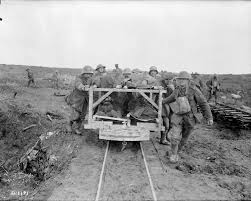
To meet these needs, the Canadian Corps built 50 kms of plank roads. These roads were subject to wear and tear from usage and shelling and required daily maintenance. They also created 20 kms of tramways to bring artillery shells to the big guns and evacuate casualties from the front. They constructed 13 “subway” tunnels that covered a collective distance of 12 kms. These passages, which were 8 meters below the surface, extended right up to the front lines and protected the troops as they massed for the attack. Most tunnels were outfitted with telephones and electric lights. There was also one with a water main that supplied the 600,000 gallons of water required on a daily basis. This system required 21 pumping stations to keep the liquid flowing through almost 70 kms of piping. Portable sawmills were set up by the forestry companies to produce the 30,000 metres of rough planking needed each week to support the building of the roads and tunnels. In addition to that, there were 1,800 kms of telephone wire laid on the surface and underground. All of this was built up over the course of six months. Once the Battle of Vimy Ridge was fought, all of this infrastructure would have to be recreated behind the new front line.


Although the front line troops get most of the credit for the tremendous victory that took place from April 9 – 12, 1917, if not for the combined efforts of the Service Corps, Ordinance Corps, Engineers, Signals Corps, Medical Corps, Forestry Companies and work Battalions the casualties rates at Vimy would have been much greater than they were.

The source for information provided in this blog comes from “The Great War” YouTube channel’s episode entitled “The Great War by Numbers” which can be accessed through the following link: https://youtu.be/QxuOxdbK-BI . The next installment of “In Flanders Fields” will deal with the tactics developed to help reduce casualties and improve the Canadian Corps chances for victory at Vimy Ridge.


Joe Corrigan has been Museum Manager at Lang Pioneer Village since February of 2003. He has been a lifelong student of history. His specific areas of interest are Canadian and world political, military and sports history with a particular focus on biographical works. Joe has been interpreting Sir John A. Macdonald at the Museum's Historic Dominion Day event since 2007.