Tuesday, 1 May 2018

Stick a Pin in This!


By: Elizabeth King

Coming up in the next few weeks, the Lang Quilting Club is getting together to start a fun new project – quilted chicken pincushions. While these little fella’s aren’t exactly “pioneer”, they are a fun, easy project that allows us to practice our quilting skills, and use up some scraps in the spirit of re-using and recycling (something that is EXACTLY “pioneer”).

Example of what we are making!

Our little project got me thinking though, where did this handy little tool come from?
First off - before pincushions we had pin cases, boxes and baskets. Metal and bone needles were expensive and precious. They were kept in “safer” containers, and treasured. But as times changed, these containers became less popular and a new item came on the scene…the pincushion!

Definition: A pincushion is a small cushion into which pins are stuck for convenient storage.

The most recognizable pin cushion in the sewing world has got to be the stuffed tomato – still available to purchase today. From what I have read, it is also one of the first pin cushion designs. This little gem came out of the Tudor era…when tomatoes were thought to symbolize prosperity and ward off evil spirits. Originally, ripe tomatoes were displayed on tables or mantles, but when ripe tomatoes were not available (and everyone realized they had a shelf life) they were crafted out of fabric and stuffed with sawdust, sand or other scraps of fabric. These replica tomatoes ended up serving another purpose in the home as well…they were perfect for holding pins.

Pincushions evolved quite a bit as the years passed - but it is safe to say they really had the royal treatment in the late 1800’s – when they got fancied up by the Victorians. Jewel encrusted, hand embroidered, doll-shaped and clamp-able … they were both lovely and useful.

While I know I am going to treasure my little quilted chicken pin-cushion, and the memories of the fun I will have making it with the Lang Quilting Club, here are a selection of photographs of some admirable examples of this sewing essential. Maybe some future Lang reproduction projects…?


Elizabeth King is the Acting Assistant Manager at Lang Pioneer Village Museum.  She has been working at the Village since May of 2009.  Elizabeth is passionate about history, costuming, reading, vegan culinary crusades and environmental pursuits. When she isn’t in the middle of a project at Lang, she is often found with her head in the clouds.


Tuesday, 20 March 2018

The Whitby Dunlops take on the World (Part 3 of 3)

By Joe Corrigan


The current incarnation of the Whitby Dunlops began a playoff series with the Stoney Creek Generals this St. Patrick's Day evening having beaten the Hamilton Steelhawks in their first contest on the road to the 2018 Allen Cup tournament. If they make it to the Allen Cup final, it will be the sixth time in their collective history with the original Dunlop team from 1955 to 1960. Back then, team Manager Wren Blair had to use all his persuasive powers to gain the right to complete for Canada's senior hockey championship.

After the 1955 - 56 season, Blair again appealed to the Ontario Hockey Association (OHA) to be designated a senior "A" franchise so the Dunlops could compete for the Allen Cup. Once again, the other senior "A" teams in the province objected to the request because of the fact that the Dunlops played in a 900 seat arena and therefore the limited gate receipts would be an economic drain on the other clubs. A headline in the Oshawa Times on Wednesday May 9, 1956 read "Senior A Delegates Doubt Whitby Would Draw Enough". Unperturbed by this rejection, Blair decided to try a different tack. If the OHA wouldn't grant the Whitby Dunlops the opportunity to join their league, Blair would create a senior "A" league of his own. It didn't take long either. On Monday, June 4th, 1956 the Times headline read "Eastern League Goes Senior A, Whitby Dunlops Have Eye on Canadian Hockey Title".

Charlie Burns with the Boston Bruins
There was a lot of excitement for the 1956 - 1957 season as the Whitby Dunlops adopted the black, gold and red colours of their sponsor Dunlop Tire Corporation and recruited some additional hockey talent. The team already included centre Bobby Attersley, former Oshawa General and perennial league scoring champ who would go on to found the Attersley Tire Company and become the longest serving Mayor of the Town of Whitby. Other notables were defenseman and captain Harry Sinden who became a coach and general manager for the Boston Bruins and the coach of Team Canada 1972 and Charlie Burns who would play for Boston, Detroit and Minnesota in the NHL. The Dunnies were the class of the league that year routinely drawing twice the Whitby Arena's capacity with the authorities turning a blind eye. A couple of local business men had recently returned from attending a college football game in the USA. They had heard a cheer there and introduced a version of it to the Whitby fans. That is where the "Go Dunnies Go!” cheer began. One of the team players admitted that once they heard that cheer the team couldn't help but "go"! This style of cheer would later spread to the Canadian NHL teams of the day. More on that later. 

1956-57 Whitby Dunlops Team Picture

The Whitby Dunlops dominated the Eastern Ontario Senior "A" League regular season and then took the Kingston CKLC's 4 games to 1 in the league semi-final. They moved on to play the Belleville McFarlands in the finals and swept the series 4 games to none. Having won the Eastern Ontario championship they then moved on to face the Kitchener Waterloo Dutchmen in the Southern Ontario finals. The Dutchmen took the first game at home and the Dunlops won the second in Whitby. The third was played at the 14,000 seat Maple Leaf Gardens due to the fact that Whitby's arena was so small. Whitby took both of those two contests for a 2 - 1 lead in the series. The finals seesawed back and forth with the series going to seven games. The Dunlops won 3 -2 in the final game to move on to the All Ontario title against the North Bay Trappers. The victory over the Dutchmen was sweet revenge taken on the hockey establishment that had barred Wren Blair and his team from an opportunity to play for the Allen Cup twice before. The Dunlops went on to beat the North Bay Trappers to take the Ontario and Eastern Canadian Championship. In the Allen Cup they faced the Spokane Flyers. All the games were played at Maple Leaf Gardens and the Whitby Dunlops became the first team to sweep the Championship series 4 games to none. Having so many of their games played on the big stage of Maple Leaf Gardens, the Dunlops became known to the Toronto sports fans. Their "Go Dunnies Go" cheer rang through the Gardens and, some say, inspired the "Go Leafs Go" and "Go Habs Go" cheers popular to this day for the fans of both the Toronto Maple Leafs and Montreal Canadiens. These were heady times for the Town of Whitby and, shortly after their Allen Cup victory parade in brand new 1957 convertibles through Oshawa and Whitby via the newly opened 401 highway, Wren Blair pronounced he would "Take the 'Dunnies' to the World Championship in Norway". 

Playing Coach Sid Smith
Once they were chosen as Canada's representative for the 1958 IIHF World Championships Blair and the Canadian Amateur Hockey Association set about to recruit a few reinforcements from the ranks of senior hockey in Ontario & Quebec. The most notable addition came when Toronto Maple Leaf executive Conn Smythe offered the services of former Leaf captain Sid Smith. Smith became the Dunlop's playing coach and joined the team in time for the Dunlop's exhibition game against the touring Soviet team in a match at Maple Leaf Gardens on November 22nd, 1957. This was the first team from the USSR to tour North America and game tickets quickly sold out. The game took place just over a month after the Soviets launched Sputnik 1 and this just added to the hype surrounding the "east meets west" contest. The game was televised with the legendary Toronto Maple Leafs broadcaster Foster Hewitt doing the play by play. The Whitby players must have been awed by the big stage because shortly after the puck dropped to start the game the Soviets had jumped into a 2-0 lead. Wren Blair challenged his team to get their heads in the game saying that if all they wanted to do was watch the Soviets play hockey they should at least have the decency to pay for a ticket like the other 14,000 spectators in the stands. That seemed to wake the Whitby team up as they proceeded to score the next 7 goals in a row beating the USSR 7 - 2. Here's a link to a You Tube video featuring the last two Dunlop goals of the game: https://www.youtube.com/watch?v=zpT8AzSmcGQ

The Dunlops left for Europe in late January 1958 from New York City on board the RMS Queen Elizabeth. They took the boat because team manager Wren Blair was afraid of flying. Prior to the World Championships they played 14 games in Britain, Germany, Sweden and Norway to tune up and get familiar with the larger international ice surface. They won all 14 games outscoring their opposition 162 to 19. The World Championships opened at the remarkable Jordal Amfi open air stadium in Oslo, Norway on February 28, 1958. The Dunlops beat Poland 14-1 on March 1st, Norway 12-0 on the 2nd, Finland 24-0 on the 3rd, Sweden 10-2 on March 6th, the Czechs 6-0 on the 7th and the USA 12-1 on the 8th setting the stage for a final showdown with the Soviets on March 9th. The USSR had won all their games except the one with the Czechs which ended in a tie. The Canadians could win the World Championships with a win over the Soviets or a tie. The final game was a tight, low scoring affair for the first fifty minutes of play. The Soviets scored first in the opening period-and it was not until late in the second period that Whitby centre Bobby Attersley evened the score with a power play tally. There was no more scoring until after the teams changed ends for the final ten minutes of the third period. This was done in international hockey due to the fact that many of their games were played in outdoor arenas where playing against the wind was a consideration. Montreal Canadiens player Connie Broden put the Dunlops ahead 2-1 shortly after the change of ends but the Soviets quickly tied the score. The tension for Canadian hockey fans listening to the play by play across the nation on the CBC radio, again with Foster Hewitt at the microphone, finally broke when "Atta Boy Attersley" put the Canadian team ahead to stay near the end of the period. Attersley's winger Bus Gagnon scored shortly afterward to put the Dunlops up 4-2. Team captain Harry Sinden embraced the World Championship trophy to bring the Whitby Dunlop's incredible journey to a successful conclusion. As a three year old I witnessed the Dunlops victory parade. Not that I remember but there is an 8mm home movie somewhere in the family to prove it. The Dunlops would go on to win a second Allen Cup in 1959. Attersley, Sinden and several other Dunlop players would join the Kitchener Dutchmen to play in the 1960 Olympics where they won a Silver medal, losing the gold to the USA. Wren Blair and other key members of the team went on to other opportunities and the Dunlops bowed out in the semi-final round of the 1959-60 senior "A" play-offs. The Whitby Dunlops were victims of a downturn in senior 
hockey’s popularity and they were unable to field a team for the 1960-61 season. 

1958 World Championship Team Picture

Wren Blair and IIHF President Bunny Ahearn

 World Champion Parade on Highway 401 
On a personal note, my dad was a big Dunlops fan back in the day. He used to say the 
Dunlops were "the best team never to play in the NHL". When the Whitby Dunlop franchise was rejuvenated in 2004 we were able to take in a number of games together and relive the glory days with the crowd reviving the old "Go Dunnies Go! cheer.     

Joe Corrigan Sr.


Joe Corrigan has been Museum Manager at Lang Pioneer Village since February of 2003. He has been a lifelong student of history. His specific areas of interest are Canadian and world political, military and sports history with a particular focus on biographical works. 

Tuesday, 13 March 2018

The Birth of the Whitby Dunlops (Part 2 of 3)


By Joe Corrigan

Although this article is scheduled to be published on March 13th, 2018, I made a point of writing it on March 9th. That was in order to observe the 60th anniversary of the Whitby Dunlops' final game of the 1958 International Ice Hockey Federation's (IIHF) World Championship in Oslo, Norway. The team that eventually would become the Whitby Dunlops started life as the Oshawa Truckmen in October of 1952. Their road to the World Championship included a number of dramatic twists and turns, the story of which is the subject of this, the second installment in Lang Pioneer Village Museum's hockey history blog.

1952 Smith Transport Truckmen
Wren Blair was a part time milkman and hockey promoter who would work his way up to being an NHL executive with a number of teams. In addition to being the driving force behind the Whitby Dunlops, he is also credited with discovering a young hockey player from Parry Sound and putting him on the Boston Bruins negotiation list. That talented young player was none other than Bobby Orr, someone I grew up watching play for the Oshawa Generals in the early 1960's. Blair pulled together a team of players from the Oshawa area to form a Senior "B" squad consisting of a number of Oshawa Generals Junior "A" alumni. The Lakeshore Senior "B" league was made up of teams from Kingston, Belleville, Orillia, Stouffville and Peterborough. On this initial roster was defenseman Ernie Dickens, a former NHL player and member of the 1942 Stanley Cup Winning Toronto Maple Leafs. The 1942 Leafs are the only team in the history of professional sport in North America to be down 3-0 in a seven game league championship series and win four games in a row to take the title. Also on that 1952-1953 team was forward George Samolenko, the first of the World Champion Dunlops to join the team. The Truckmen were sponsored by the Smith Transport Company, an Oshawa based firm with ties to General Motors and which was reputed to be the largest trucking company in the "British Empire". The Truckmen had a strong season playing out of the Hambley Arena posting 20 wins against 8 losses and no ties in the regular season. They took on the Stouffville Clippers in the league's first to 8 points semi-final posting 4 wins and 1 tie to move on to the final against the Kingston Goodyears. The final went the full seven games with Kingston edging out Oshawa 4 games to 3. Of note, the Truckmen played the East York Lyndhursts, Canada's representative at the 1954 IIHF World Championship in an exhibition match on New Year's Day 1953.  

1953 Playoff - Truckmen vs. Clippers

1953 Oshawa Arena Fire
The 1953-1954 hockey season looked promising indeed for the Truckmen however fate was to hand them a cruel blow when their home arena burned down on September 14th, 1953 taking all their equipment with it. The Junior "A" Oshawa Generals suspended operations until 1960 while efforts began to build a new arena, the Oshawa Civic Auditorium, which opened to the public in 1964. Wren Blair didn't let a little thing like not having a home arena and no equipment stop him from fielding a team for the upcoming season. With a loan of equipment from the Bolahood Sporting Goods Store, Blair moved the team to Bowmanville where they played their regular season home games. They achieved a regular season record of 22 wins, 18 losses and 0 ties but attendance was disappointing in Bowmanville. They played their first home playoff game in the Lakeshore Senior "B" League semi-final in Bowmanville. Attendance was so poor, Blair made the decision to play every-other playoff game in their opponent's home arena or a neutral site so that the Truckmen could increase their share of gate receipts. Oshawa went on to beat Kingston 4 wins to 1 in the Lakeshore league semi-final and Peterborough 4 wins to 1 with a tie in the league final to claim the title. That allowed the Truckmen to play for the Eastern Ontario Senior "B" Championship against the Stouffville Clippers which they won 4 games to 1. They then put their 12-3-1 playoff record on the line to take on the Simcoe Gunners for the All Ontario Senior "B" Championship. All the final games were played in Simcoe, Ontario with the Truckmen winning the series with a 4-0-1 record. A remarkable feat as they are the only team in the history of the league to win a championship series without ever playing a home game.


Truckmen vs. Lyndhurst 1953
1954 Senior B Champs- Truckmen

1956 Whitby Arena
Then as now, only Senior "A" teams can compete for the Allen Cup, symbolizing the National Senior Hockey Championship of Canada. After the 1953-1954 season, Wren Blair appealed to the Ontario Hockey Association to have the Truckmen designated as a Senior "A" team he was so convinced of the quality of his team. The league, which was dominated by Western Ontario franchises like the Kitchener Dutchmen, turned him down as a team with such poor attendance wouldn't provide the league with enough revenues to make it worthwhile. On top of this, the Bowmanville experiment had proven a failure and the team had lost their sponsorship as well. Searching for a place to play for the 1954-1955 season, Wren Blair arranged to move to Whitby Ontario to play in that town's newly built 900 seat arena. The team started play as the Whitby Seniors while Blair contacted the president of the Dunlop Tire Company, a British company that had just built a large manufacturing plant in Whitby based on the town's proximity to the General Motor's plant in Oshawa, to ask for sponsorship. When Dunlop Tire sent him a cheque for $1,500 he sent it back to the President of the company with an angry letter. Confused at this stormy rebuff, the Dunlop President met with the Mayor of Whitby who explained that the Whitby Seniors were equivalent to a tier two soccer team in England. On January 19, 1955, a group of 15 officials from the Dunlop Tire Company were invited to attend a Whitby Seniors game and have dinner in the Arena. The visiting team was the Kingston Goodyears, sponsored by a rival tire company. At the intermission Wren Blair came into the dressing room and told his players that the Dunlop Tire Executives had raised $200 for the players to split if they beat the Goodyears, which they proceeded to do. On Tuesday, February 1st, 1955 the Oshawa Times headline read "Dunlop Will Sponsor Whitby Senior Team" and the Whitby Dunlops were born! The Dunlops were edged out in a highly competitive playoffs series by the Kingston Goodyears to end their initial season in Whitby. It would be the last playoff series or championship the Dunlops would lose until 1960.

Whitby Dunlops 1954-55 Game Action

1955 Whitby Dunlops vs. Peterborough Petes


 Joe Corrigan has been Museum Manager at Lang Pioneer Village since February of 2003. He has been a lifelong student of history. His specific areas of interest are Canadian and world political, military and sports history with a particular focus on biographical works. 

Tuesday, 6 March 2018

Looking Back to Another Time When Canada's Hockey Hopes Rested on Non-NHL Players (Part 1 of 3)


By Joe Corrigan

There was a great deal made about not sending players from the NHL to the 2018 Olympics in Pyeong Chang and how it would impact the quality of the tournament. In the end, what resulted was one of the most competitive and exciting competitions for a gold medal in recent years and it afforded the opportunity for a number of former NHLers and minor league pros to achieve a hitherto unattainable dream, an Olympic medal.

Having top calibre professional athletes competing in the Olympics is only something that has been in place since the 1990's. Before that, a code of amateurism (although I hesitate to use the word "strict" given the way it was applied) prohibited professionals from taking part. From the first Olympic ice hockey tournament in Antwerp, Belgium in 1920 until the Nagano games in 1998, Canada was represented by senior amateur teams from Winnipeg, Toronto (Granite Club and U of T Grads), Port Arthur, the Royal Canadian Air Force, Edmonton and Kitchener-Waterloo. That was also true of the International Ice Hockey Federation's (IIHF) World Championships where Canada was represented by towns like East York, Ontario, Belleville, Ontario, Trail, B.C., Penticton, B.C. and, my home town, Whitby, Ontario. This week marks the 60th anniversary of the Whitby Dunlops Senior "A" hockey team representing Canada at the World Championships in Oslo, Norway.     

Left to right: RCAF Flyers- 1948 Olympics, East York Lyndhursts- 1954 World Championships, Penticton V's- 1955 World Championships, Kitchener-Waterloo Dutchment-1956 Olympics, Belleville MacFarlands- 1959 World Championships

To have an understanding of the atmosphere around the 1958 World Championships it is necessary to see the tournament within the context of international politics. The mid-1950's represented a very tense time in world history. It was the height of the cold war and the dawn of an era of great advancement in nuclear and space technology. The advent of the atomic bomb which ended the Second World War gave humanity a glimpse of its potential ultimate destruction. The Union of Soviet Socialist Republics (USSR) under Joseph Stalin was involved in international intrigue against the west and McCarthyism, where the United States Senate's Committee on Un-American Activities was making accusations of Communist affiliations against authors, playwrights and others in the entertainment industry without due process, brought an end to many careers. Adding to the paranoia, the Soviets had tested their own atomic bomb in 1949 becoming the world's second atomic power after the United States. The USSR's control of Eastern Europe was referred to by Winston Churchill as an "iron curtain" descending upon Europe. The construction of the Berlin Wall, the invasion of Hungary in 1956 and the military suppression of the Hungarian revolution were greeted with outrage in the west. Add to that the incredible folly of Great Britain and France invading Egypt to cease control of the Suez Canal that same year which only served to split these two allies from the United States. To say that the situation was tense would be an understatement. Fortunately, with regard to the Suez crisis, the world was pulled back from the brink by Canadian Foreign Affairs Minister, and later Prime Minister, Lester Pearson's peace keeping force proposal. 1957 saw another deeply troubling development for western nations when the USSR launched the world's first orbiting space satellite, "Sputnik" on October 4th. It was against this geo-political backdrop that a senior hockey team from Whitby, Ontario (population 6,000) would take to the ice and challenge the Soviet Union for the World Ice Hockey Championship supremacy in the cause of freedom and the western democracies (perhaps a little over dramatic but that's what it must have seemed like to the players at the time).       

If the politicians of the world were concerned with the Soviet's threat of world domination, so too were Canadian hockey enthusiasts. Prior to World War II, Canada dominated international ice hockey competitions. Our teams often embarrassed other countries with lopsided scores and strings of shut out victories. The only time that a Canadian team lost an Olympic title in those days was at the 1936 Games in Garmisch-Partenkirchen, Germany when we underestimated a team from Great Britain made up entirely of ex-patriot Canadians. That changed with the post-war era. The Soviets planned their move so that when they did finally appear on the international ice hockey scene it would be as a dominant force. Canada won both the 1948 and 1952 Olympic gold medals but that would mark the end of our Olympic championships until 50 years later at the 2002 Winter Games in Salt Lake City, Utah with NHL professionals under the guidance of General Manager Wayne Gretzky and a brain trust of Canadian hockey elites.   

Canada didn't enter a team in the 1953 IIHF World Championships which was staged in Zurich, Switzerland and competed between European nations. Sweden claimed its first title that year. In 1954, Canada had trouble finding a team to represent our country in the event. In a moment of hubris, the powers that be settled on a Senior "B" level team, the East York Lyndhursts (named after a local car dealership). The Lyndhursts played in the local East York Senior "B" league of which they weren't even the champions. They had lost the league semi-final in the 1952-53 season and the final in 1953-54, immediately before going to the World Championships which were held in Stockholm Sweden. Despite their junior stature on the Canadian senior hockey scene, they did quite well in their first 6 games. They ended the tournament with a goal differential of +47 and a 6-1 record. The only problem was that they ran up against a superior Soviet team in the final game and lost 7-2 in a lopsided contest. The finger pointing at home started immediately. The Lyndhursts, despite being set up for failure, were a stain on the nation's hockey honour, especially in losing to the upstart "Russians". The Canadian hockey hierarchy was determined to get revenge and sent the legendary Penticton "V's" to reclaim the trophy, which they did at the 1955 tournament in Dusseldorf, Dortmund, Krefeld and Cologne, West Germany. The V's had an 8-0 win loss record and a +60 goal differential. They went on to demolish the Soviet team 5-0 in the final game of the tournament bringing the title home for the 16th time. Rumour has it the V's brought home more than the title. When it came time to return the trophy to the IIHF for the next year's tournament, they supposedly sent back a replica, retaining the original in the Penticton arena!

1954 World Championship Opening Ceremony
Soviets vs. Canada - 1954 World Championship
Championship Trophy & CCCP Sweater

The V's triumph was short lived. There was no 1956 World Ice Hockey Championship as it was an Olympic year. Canada's gold medal hopes rested on the shoulders of the Kitchener-Waterloo "Dutchmen" at the games in Cortina d'Ampezzo, Italy. The Canadian team finished third behind the Soviets and the United States. The 1957 World Championships took place in Moscow, USSR. Canada and the United States boycotted the tournament in protest of the Soviets military intervention in Hungary the year before. The trophy was competed for by European nations and a team from Japan. Sweden won their second championship title that year with the Soviets finishing second. That set the stage for the 1958 World Championships in Oslo. The Whitby Dunlops' road to that tournament will be the subject of part two of this blog.


Joe Corrigan has been Museum Manager at Lang Pioneer Village since February of 2003. He has been a lifelong student of history. His specific areas of interest are Canadian and world political, military and sports history with a particular focus on biographical works. 

Tuesday, 27 February 2018

The P.G. Towns and Sons General Store Lives On at Lang Pioneer Village


 By Joe Corrigan


The hamlet of Douro lost a treasured landmark when the P.G. Towns and Sons General Store burned down early in the morning of Friday, February 2nd, 2018. The fire in the store, which was over a century old, was noticed by a passerby at around 1:00 am. By the time the local firefighters could get to the scene the store was fully engaged and nothing could be done to save the structure. The fire was so intense that there was nothing left of the building and no evidence remained as to what had caused the blaze. Obviously the loss of the store has had a big impact on area residents who have known it as a fixture in their community for all of their lives. Although the Towns General Store no longer exists, its essence lives on at Lang Pioneer Village thanks to the efforts of a former member of the Museum’s staff. 


Fire at the Town General Store- Photo by Clifford Skarstedt/Peterborough Examiner

Back in 2003, Lang Pioneer Village Museum began a major project to restore its two, 19th century Jacquard looms. These machines, which used punch cards to develop very intricate patterns on the textiles they produced, were revolutionary during their time in the early 1800’s and represent one of the earliest uses of binary code technology in human history. Simply put, these looms were the ancestors of computer technology. 

Jacquard Loom at Lang Pioneer Village Museum- Photo by Caleb Hunt
Jacquard Punch Cards

Master weaver Didier Schvartz set about the complex task of restoring the looms and their mechanical heads so that they could be re-assembled and made operational. This work was completed by 2005 but, in order to protect these priceless artifacts and interpret them appropriately in a living history environment, an environmentally secure and period authentic “weavers shop” was required. That’s where Exhibit Artist Audrey Caryi came into the story.
Audrey, a gifted artist in her own right, had been working at Lang Pioneer Village for a number of years and had been involved in several significant building projects at the Museum. Lang’s mandate is “To preserve, promote and authentically recreate the history of Peterborough County” and, during her 34 year tenure at the Museum, Audrey was renowned for her passion for authenticity. Prior to her involvement with the weavers shop at Lang, Audrey had created concept drawings for the Museum’s Ash House, Smoke House and Ice House. All were accurate representations of structures that were not only specific to their unique roles and time periods but also to the region. In 2006 Audrey was tasked with the challenge of coming up with a concept drawing for the weavers shop which would be the basis on which architectural and engineering drawings would be developed.

Audrey Caryi, Lang Pioneer Village Museum's Exhibit Artist / Museum Specialist from 1983 to 2017

Audrey set out to come up with a design that would represent a home based business and be typical of a late 19th-century artisan weaver. The looms had been owned by a man named Samuel Lowry who worked out of Warsaw back in the 1880’s and that determined the era and the geographic location which would inspire Audrey’s design. Once that had been determined, Audrey set out for a tour of the region with her good friend Carol Hamilton to seek inspiration. She found it in Douro. Audrey saw the Towns General Store as the ideal representation of what a weaver shop should look like.


An early image of the Towns General Store

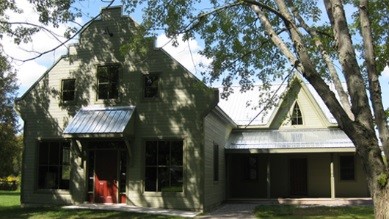
Audrey set about to capture her idea on paper with her signature pen and ink drawings. From the outside, the front “weavers shop” section of the building captured the shape and style of the Towns General Store’s two-story façade.


The Samuel Lowry Weaver Shop and Jacquard Loom Interpretive Centre at Lang Pioneer Village (circa 2011)

The interior of the shop is set up to represent a weaver’s work area with a counter, cupboards, supplies, textile samples displayed on the walls, working two-harness and four-harness looms and static display Jacquard loom. The entire building is a single story on the inside to accommodate the height of the Museum’s two Jacquard looms which, when restored, stand 10 to 12 feet high.

Interior of the Weaver Shop - Photo by Caleb Hunt

The portion of the building behind the weavers shop is meant to represent a two story home when viewed from the outside. Inside it becomes an interpretive area that houses the Museum’s working replica Jacquard loom and a stairway which leads to an elevated viewing platform so visitors can experience the workings of the loom from a 360 degree perspective. There is also room for educational activities and displays related to the Jacquard loom, textiles and, in the future, the evolution of binary technology.

Regrettably, Audrey passed away in April of 2017. Her contribution to the region’s visual arts was recognized with her induction into the Peterborough Pathway of Fame in September of 2017. Fittingly, Audrey’s marker on the Pathway is in close proximity to the Peterborough Art Gallery. Audrey’s legacy lives on in the historic Village through her work in the conceptualization of the Weavers Shop, and in turn, so does the Towns General Store. 
   
Official Opening of the Jacquard Exhibit in August of 2015 - Photo by Larry Keeley
   

Joe Corrigan has been Museum Manager at Lang Pioneer Village since February of 2003. He has been a lifelong student of history. His specific areas of interest are Canadian and world political, military and sports history with a particular focus on biographical works. Joe has been interpreting Sir John A. Macdonald at the Museum's Historic Dominion Day event since 2007. 


Tuesday, 30 January 2018

In Flanders Fields (Re-post)

The following blog entry was originally posted in 2015. In honor of the 100th anniversary of John McCrae's death this past Sunday, we have decided to re-post this entry.

Centennial Anniversary Event – May 3, 1915 – In the immortal Words of …

By Joe Corrigan

The 2nd Battle of Ypres, the first time Canadian troops had been engaged in a major battle of the First World War, was in its twelfth day and the casualties had been very heavy. The field hospitals were all but overwhelmed with the flood of wounded and gassed soldiers they were faced with. In the midst of all this chaos, a senior medical officer took the time to preside over the funeral of his close friend, Lieutenant Alexis Helmer. The doctor had been treating casualties in an 8’ by 8’ bunker just behind the Yser canal about two miles north of Ypres. After the service, the physician, who was also a poet and author, wrote a 15 verse poem to express his feelings on the loss of his comrade and the need to carry on the fight so that his sacrifice and those of the fallen would not have been in vain.
Major John McCrae
It only took twenty minutes to complete and the poet was not pleased with his work and tossed it aside. Fortunately, someone was able to convince him of the worth of the piece. In December of 1915, the poem was published in the British magazine “Punch” and its verses have been a part of almost every Canadian commemoration of Remembrance Day ever since. The physician poet was Major John McCrae originally of Guelph, Ontario and his poem was “In Flanders Fields”.

I recently read an article that compared McCrae’s poem with Abraham Lincoln’s Gettysburg Address. Both pieces are brief and powerful, pay homage to the fallen and urge the audience to carry on the struggle. It is ironic that, given the continued popularity of both works, neither of these two men felt their words could adequately express the sentiments they wished to convey. As noted, McCrae discarded the poem at first and, in his own words, Lincoln concluded that “the world will little note, nor long remember what we say here.” Yet today, both these literary works live on and, in the commemoration of their subject events, bring generation after generation a newfound appreciation of the “brave men, living and dead, who struggled here.” As a Canadian and a hockey fan I should like to note that both the Montreal Canadiens and the Toronto Maple Leafs, teams that were founded in the early 20th century, take inspiration from the sacrifice of Canadians in the Great War. The Toronto Maple Leafs crest is based on the “CANADA” maple Leaf badge pictured with this article and worn by the vast majority of our soldiers in World War I. Les Canadiens make use of the torch as a symbol to urge their players to carry on the great tradition of the team; one that has 24 Stanley Cup Championships. Far and away the most of any team in the NHL.

John McCrae, by then a Lieutenant Colonel and Commanding Officer of No. 3 Canadian General Hospital at Boulogne, died on January 28, 1918 of pneumonia and meningitis. He was buried with full military honours in Wimereux Cemetery in a service that was attended by Sir Arthur Currie, Commanding General of the Canadian Expeditionary Force. A collection of his poetry entitled “In Flanders Fields and Other Poems” was published shortly after his death in 1918.   

In the immortal words of John McCrae:

 “In Flanders Fields”
In Flanders fields the poppies blow
Between the crosses, row on row.
That mark our place, and in the sky
The larks, still bravely singing, fly
Scarce heard amid the guns below.

We are the Dead. Short days ago
We lived, felt dawn, saw sunset glow.
Loved and were loved, and now we lie
in Flanders fields.

Take up our quarrel with the foe:
To you from failing hands we throw
The torch; be yours to hold it high.
If ye break faith with us who die
We shall not sleep, though poppies grow
In Flanders fields.  

John McCrae with his dog Bonneau

To learn more about the writing of the poem “In Flanders Fields” check out the April-May edition of Canada’s History magazine which has an article by J. Andrew Ross entitled “Born of Fire & Blood.” Ross contends that “When John McCrae wrote ‘In Flanders Fields’ a hundred years ago he unleashed a force more powerful than any weapon of war.” As mentioned in my previous blog; Steve Guthrie of CHEX Television News produced a two part segment on the 57th Regiment of Militia, Peterborough’s militia regiment prior to World War I, and the participation of local troops in the 2nd Battle of Ypres. The two YouTube videos are posted on Lang Pioneer Village Museum’s Facebook page. Other interesting documentaries on the First World War include historian Norm Christie’s series entitled “For King and Empire” and the BBC documentary entitled “The Great War’ which dates from the 1960’s and includes interviews with people who experienced the events first hand. Canada’s History magazine has published “Canada’s Great War Album” which includes historical perspectives from a number of noted authors along with a collection of personal stories passed down from descendants of the soldiers and others who lived in those times. During the next three years, we will continue to mark notable anniversaries of Canada’s involvement in the Great War.


Joe Corrigan has been Museum Manager at Lang Pioneer Village since February of 2003. He has been a lifelong student of history. His specific areas of interest are Canadian and world political, military and sports history with a particular focus on biographical works. Joe has been interpreting Sir John A. Macdonald at the Museum's Historic Dominion Day event since 2007.